1939 and the war was on the horizon. The Germanic States leadership was pushing Europe's buttons. It had taken over all the easy pieces of territory and was now faced with the more difficult areas like Poland, the low countries and Scandinavia. It was felt by the Germanic States that it would be able to take over those countries and remain not at war with Britain and France. September 1939 and the Wehrmacht roles into Poland, much to the Germanic States Leadership is surprised to find themselves at war not only with France but the Commonwealth as well. Otherwise Argentina and Chile set the world afire.
Lemuria was proposing the design for a new cruiser, that would be more capable than the Menabe type. The first Menabe appeared in 1935 and was a very useful cruiser. But it was really too small for the Fleet and Patrol work required against the enemies they would be likely to meet at sea. Possible new designs ranged from eight, to ten, to twelve 6" gun armaments. To take the various armaments would require ships from 570 to 620 feet. Other things that would need taking notice of was the secondary armament, either a 4" or 4.5" turret set from eight to twelve guns. Aircraft handling equipment. Speed requirements would vary with the amount of armour to be fitted. The faster the ships then armour may not be as thick as required unless overall size and dimensions are increased to handle all that the designers might want. A Super Light Cruiser.
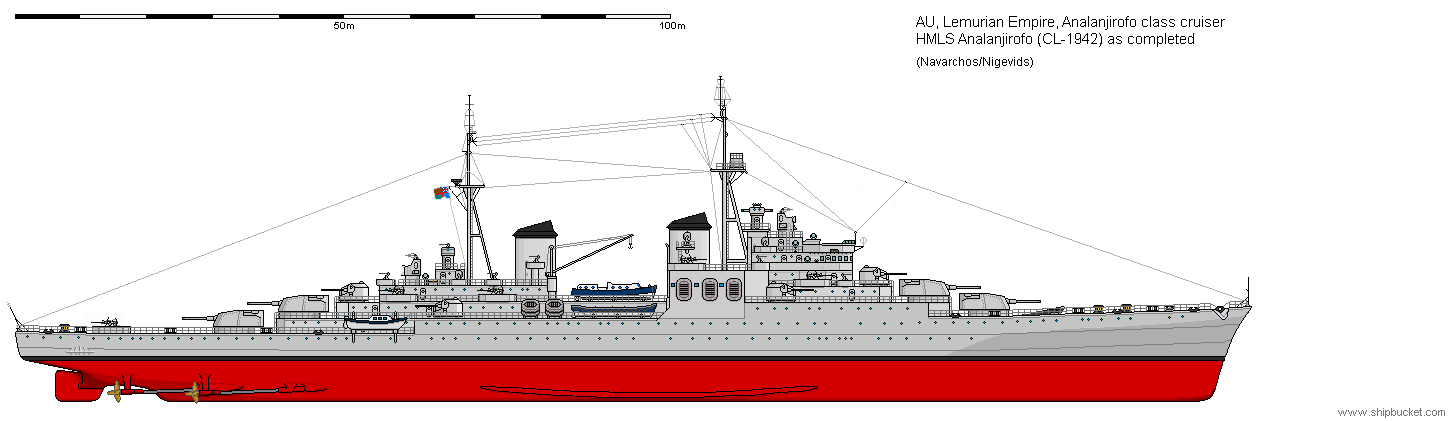
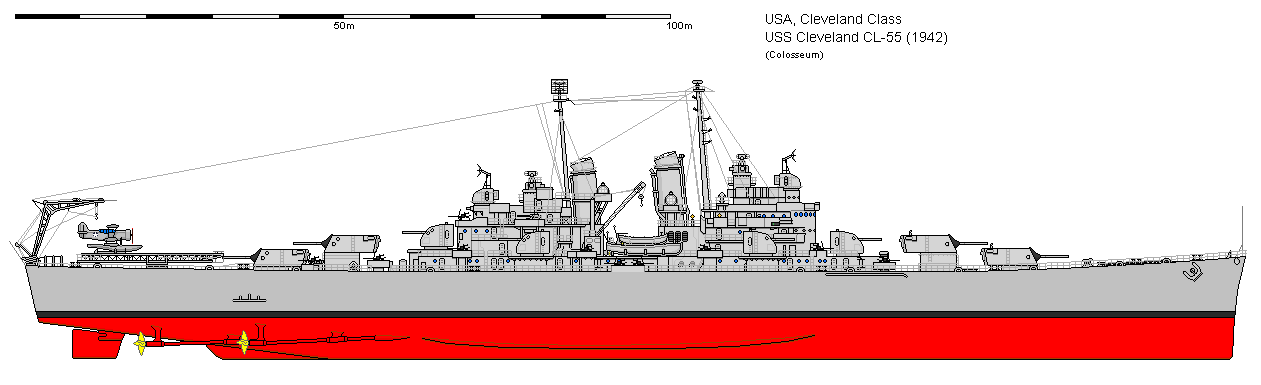
My thought for this cruiser was a British Cleveland type. I think I got it pretty good. I certainly like the look of the Analanjirofo, a good solid cruiser.
The Lemurian Navy got what they wanted. The design evolved during the design process then again the ships changed during the building phase. The original design showed aircraft and torpedo facilities, but these had been removed by the time the ships would join the Fleet. Quad 40mm and predictors were fitted from the start, while radar sprouted from all the masts, and tops of the directors. The Analanjirofo joined the fleet in September 1942. Its five sisters started with January 1943, June 1943, March 1944, February 1945, April 1946. The last three took longer than the first three as priorities changed late in the war. The first four completed to the same standard as the Analanjirofo set. The last two had major changes to the masts, the tripods being replaced with lattice masts. A fresh set of radar and electronics were fitted to those last two ships as well.
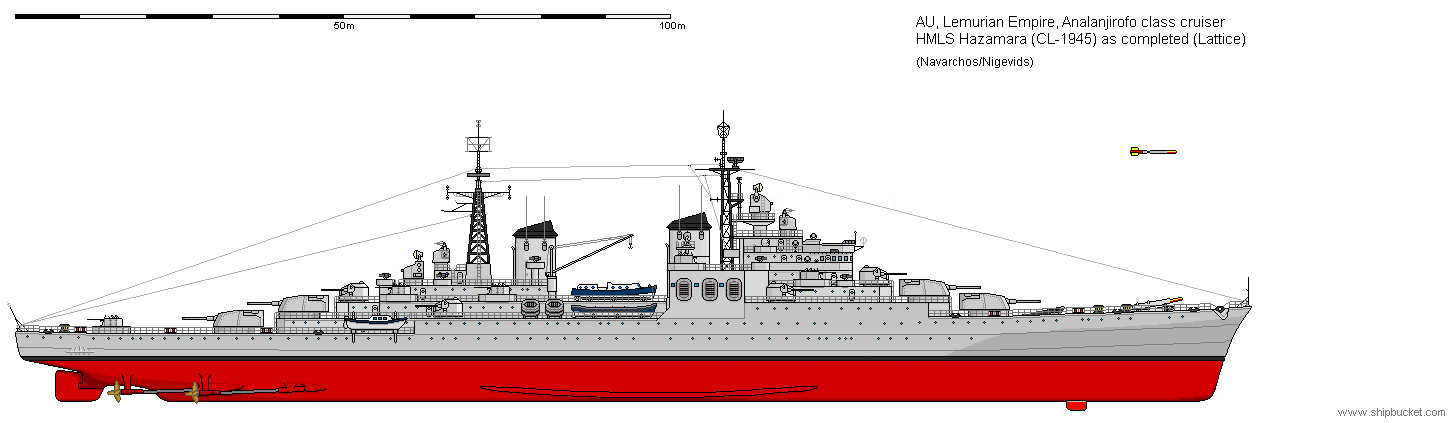
Two major armament changes were made to the last two ships. The quad 40mm mk.1 were replaced with twin 40mm mk.V mountings. The mk.V was an all round better weapon than the earlier ones. Coupled with a new radar predictor unit, also improved accuracy. The second change was the experimental fitting of a fixed, twin, R.A.T.S. (Rocket Assisted Torpedo System) mounting. To control this weapon, a radar controller was mounted beside the bridge to get the torpedo either to the coordinates of the surface target or to the supposed target area for the torpedo to enter the water in anti-submarine mode. For both targets the torpedo was fitted with a homing sensor.
The first two ships were fully engaged in the war, the Analanjirofo went to the Mediterannean on completion and fought with the Fleet units against the Italian Navy and German and Italian aircraft. Once the airfields on Sicily were taken by Allied forces the need for the big Fleet carriers was no longer required. These were replaced with smaller CVL's to provide Combat Air Patrols and Anti Submarine warfare aircraft. The bombardment forces came down to cruisers, destroyers and monitors. Ships that the High command would prefer to lose rather than the capital ships. What had happened to the Roma was fresh in their minds. The Analanjirofo was lucky, it received a hit from a Fritz-X that would have sunk one of the cruisers that still had aircraft handling facilities. With the hangar on the Analanjirofo broken up into offices there was no fuel tanks for the refueling of the aircraft. Nothing to cause a major fire. The Fritz-X exploded in the hangar area and did not penetrate to the bottom where if it had exploded it would have broken the back of the ship. The Analanjirofo was withdrawn to Alexandria for repairs before being returned to Lemuria for more extensive work. On completion of the refit the Analanjirofo went on to join the newly formed Commonwealth Pacific Fleet. It stayed with the fleet and acted more in the AA role and as an interference unit between the Kamikazes and the aircraft carriers. In that role it received splinter damage when a Kamikaze crashed into the sea within 20 meters of the ship. The war ended and the Analanjirofo returned to the shipyards at Colombo where a full survey of the ship was undertaken before it was to receive the lattice mast refit. The survey found the hull had warped from the Fritz-X hit. The Analanjirofo would carry its present armaments and refit level as Flagship of Coastal Forces East. The Analanjirofo would be withdrawn from that position in 1957 and sold for scrap.
The Colombo was lucky to be able to pass through the Mediterannean to join other Lemurian forces with the Home Fleet at Scapa Flow. The Colombo would follow the two King class battleships around their deployments and battles. The Colombo was one of the guardships for the carriers at the Battle for JW-60' The carriers were the main target for the Fritz-X bombers and the carriers had a cruiser on either side to try and intercept any of the bombs coming toward the carrier it was guarding. Where the Analanjirofo had been lucky with its Fritz-X hit, the Colombo was not lucky. The bomb penetrated forward of the bridge through the gap between 4.5" and 6" turret. penetrating through to where the 4.5" magazines were when it exploded. The explosion set off the 4.5" magazines, which blew out the bottom of the ship. The Colombo staggered to a stop and sent out the message, "Require assistance". The Fleet passed it by and one of the guard destroyers came alongside and took off the survivors. The destroyer pulled away then put two torpedoes into the hulk, sinking it.
The next two ships joined the Pacific Fleet on completion and went through the battles that the fleet encountered on its way to defeating the Japanese when Japan surrendered after the atomic bombs dropped on Hiroshima and Nagasaki. The two ships returned to Lemuria and the Colombo dockyards. Both ships would go through the 'lattice' mast refit bringing those two ships up to the standard of the Hazamara type. The two ships would fight at Korea and Vietnam. They would not be considered for conversion to missile cruisers, but would be retained as gun cruisers for all their service through till 1970 when they would be removed from the active list and sold for scrap.
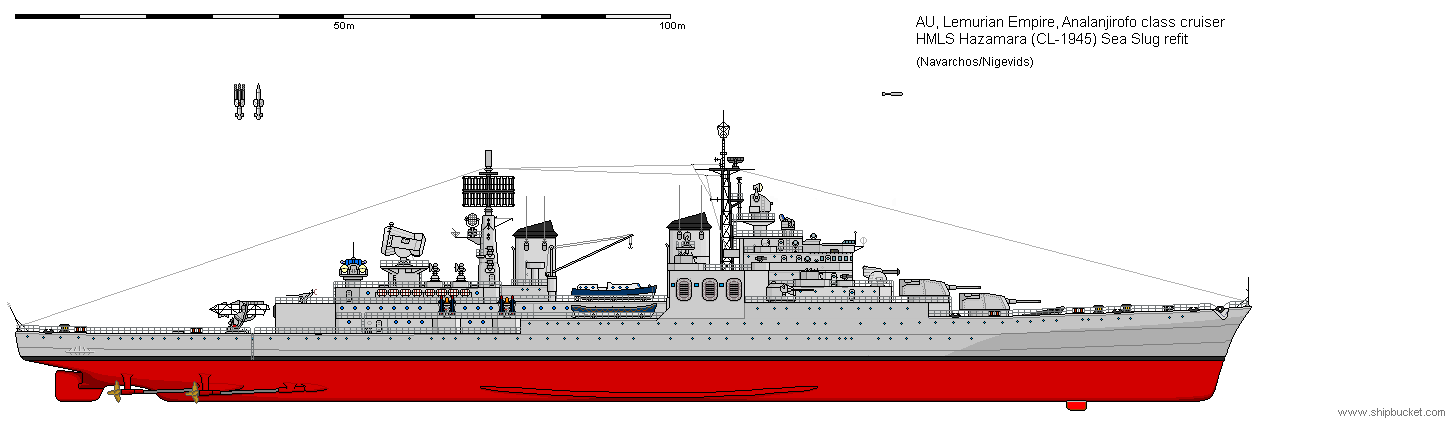
The last two ships missed World War Two, which was probably an advantage for ships to be kept in the Post-War Navy. Except for their acceptance trials neither of the ships had been used past 80% of full power on the machinery. Both ships fought at Korea with the Fleet. Then on their return to Lemuria they were at the mouth of the Red Sea for the Suez Crisis. The crisis over the two ships returned to the Colombo Dockyards, they were both earmarked for conversion to missile cruisers. They were not big enough or new enough to be considered for NIGS missiles, they would be fitted with Sea Slug. The RATS mounting would be removed. An American Weapon A (Alpha) was placed forward in place of the 4.5" mounting. The Hazamara would run the trials on this system. This was possible as the Hazamara still had the surface and subsurface locator equipment that had been used with the RATS system.
They would use their missiles off the coast of Vietnam until the Lemurian Forces were withdrawn. Neither ship was still in commission at the Falkland Islands Battles, having been removed from service in 1980 and sold for scrap.