The King Andriantsitakatrandriana (Andy) Class cruisers took the Vatovavy type to a new level. The Vatovavy had proved very seaworthy with a fast hull, which was incorporated into the new 'heavy' cruisers. A completely new layout with cross deck catapult and hangars either side of the fore funnel gave the ships a completely new look. It was the bridge and mast that were pointers to the ships Vatovavy lineage. The new triple 8" turret was from plans received from the Royal Navy and the designers could only find room for three on a ship limited to 10,000 tons. The eventual design grew to 11,250 tons standard which was better than some countries that went 40-50% over the base tonnage. The armour scheme was the main reason for the extra tonnage. The 4" belt armour was needed to have a chance to defeat the 8" shells from other nations.
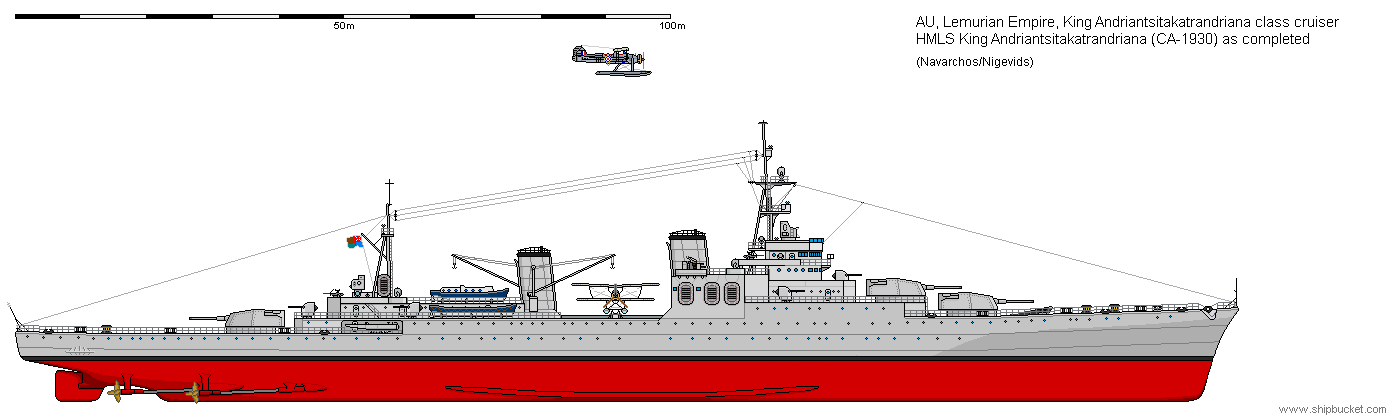
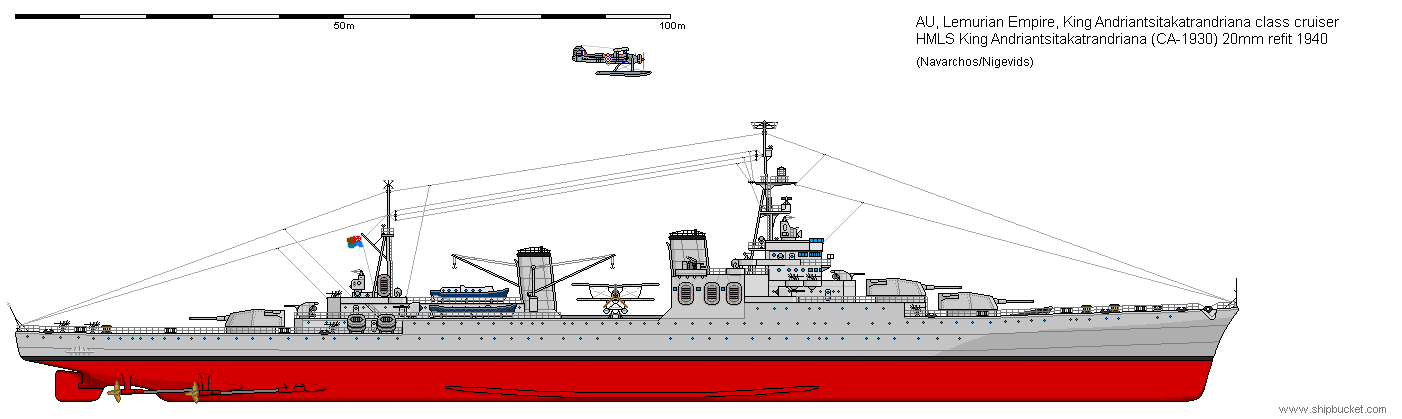
The two ships first deployment was with the Andrianerinerina to form the 1st Cruiser Squadron. The ships were tasked with being the close support group for the Carrier force. The importance of this duty increased as more carriers were added to the Fleet. The period 1930 to 1940 did not change the ships much. 1937 the single inline 4" fore and aft were replaced with twin mounts. The 1939-40 refit was to replace the single 2pdr with 20mm and to add more electronics to the ships. During this refit they lost the torpedoes. Because of this they missed the battle with the Tirpitz. (see Andrianerinerina)
The carrier Ambohimanga had gone to join Force H, and these two ships joined it there. The big battles with Axis Command North and Axis Command Central engaged all of the available Allied Forces . The aftermath of those battles was the Axis were able to have a ship slip into the Atlantic unnoticed. (see Moltke) RRR calls started as the Axis ship got amongst the small convoys heading north to join the major convoys that would leave from Nova Scotia. To run down this raider would require several hunting groups. These two ships joined the South African battlecruiser (see Sud Afrika) along with a light carrier (see Chronos) as the teeth of the search. Various small cruisers were out on the trade routes and they would use their aircraft (if they had any) to help spot the German ship. It took five days of all out searching until finally the Moltke was spotted and identified. This was done by aircraft off a Hestia class cruiser. The Hestia was fast enough to shadow the Moltke and vector the hunters onto the target. It took all night for the FH-1 Squadron to reach a position where the aircraft off the Chronos could reach and attack the Moltke. A full strike of 12 aircraft was launched (all that were aboard) and they were vectored onto the Moltke by the Hestia.
The Moltke was superbly handled. Only one bomb and one torpedo hit the ship from the twelve aircraft. More importantly one fighter, and three bombers were shot down. The Moltke had to know something was coming and had launched its three aircraft at first light. These were held in reserve as a last stand against an air attack. Once the Moltke had seen how many and of what type of aircraft had been sent against it, the Combat Air Patrol was called in to intercept the bombers. These were the vulnerable Swordfish operating off a small carrier. The three Arados shot down two torpedo bombers and a fighter for the loss of two of their own, ship AA got the other one. The aircraft from the Chronos had been overconfident, and the loss of four aircraft made another strike with only three bombers and two fighters (the other survivors being damaged) not viable.
The bomb hit hit the afterbridge and knocked out the secondary main director. The torpedo hit was on the main belt at its thickest part and while it caused damage and slowed the ship to 27 knots, the Moltke was still an effective unit. The remaining fighters were sent back to find and shoot down the remaining Arado and then act as spotters for the Cruiser Squadron now tasked with finishing off the Moltke. The stage was set for an old fashioned gun duel where the Allied ships had the advantage of both numbers and with the Sud Afrika a much bigger ship. The Moltke started shooting well and had straddled and hit the Sud Afrika several times without causing any critical damage. The Sud Afrika was also shooting well and caused the battle winning shot when a 12" shell hit the fore superstructure knocking out the main director. Thereafter the Moltke's shooting was in local control and nowhere near as effective. Once the two Lemurian cruisers joined the battle and their shells kept causing more and more damage the end of the Moltke was in sight. Two devastating broadsides from all three ships hit the Moltke and dismounted, destroyed and knocked out all four main turrets of the Moltke. Suddenly the Moltke was a wreck waiting to be sunk. The Hestia, that was acting as guard ship to the Chronos, was tasked with torpedoing and sinking the hulk.
The two ships rejoined Force H and went on to fight all the battles that went with the retaking of the Mediterranean and the defeat of the various Axis countries. When due for refits the two ships would go either to a UK port or Atlantis. Neither ship ever had the 2pd quad mountings replaced with 40mm. It was felt that the ships were getting too old to waste too much valuable inventory on, which would be better fitted to more modern ships.
At wars end the two ships were filled with Lemurian Troops, being returned from Europe, and sent back to Lemuria. There they were reduced to the reserve and their crews sent to join newly completing ships , if applicable. Only full Lemurian Navy personnel would go to new ships. Hostilities Only crew would be discharged and returned to civvy street. Both ships were struck from the Navy List in 1948 and sold for scrap.