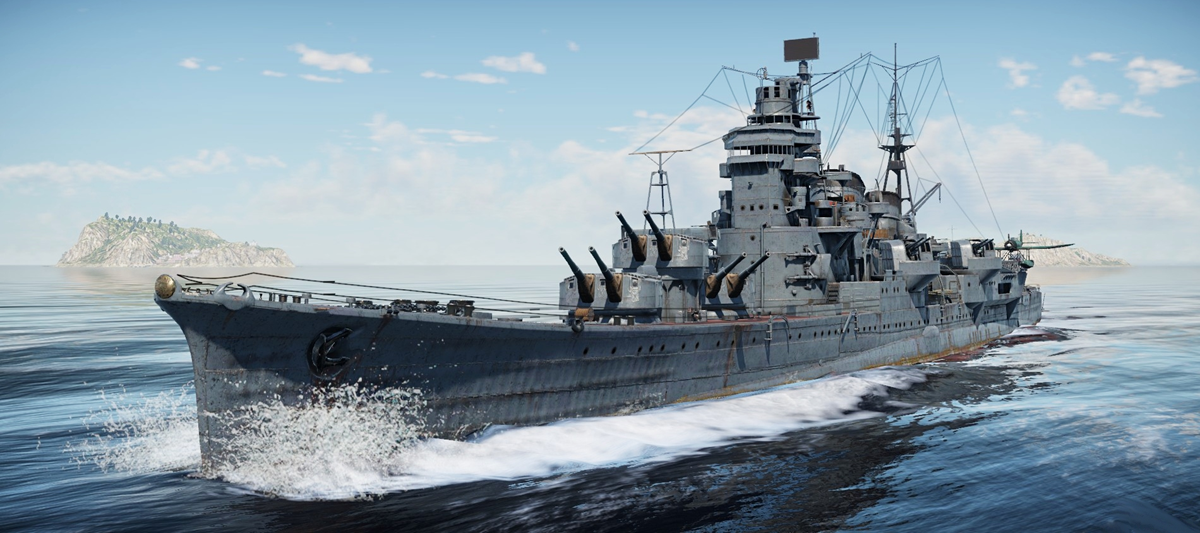
The Lemurian Navy finished World War One with more ships than it knew what to do with. Obviously the modern war built ships would be kept. The problem was that so many of the older pre war ships were now obsolete. A lot were only just over ten years old, but.... Not fast enough, not enough armour (if required), guns not big enough, or enough of them. Some had to be kept as their replacements were still being completed at the end of the war. A lot of ships needed to be laid up as the crews that had been aboard were paid off and returned to civilian life. Which is when the "Spanish Flu" struck around the world. The armed forces of the various nations involved in WW1 transported the virus to their home countries. The Spanish Flu is credited with killing more people than WW1 did.
The Lemurian Navy had to keep its 16 old 'L' class destroyers despite them being to slow to properly escort the modern Battleships. Not enough of the Charlemagne class were built to replace them immediately. A new class of destroyer was to be designed, incorporating all the lessons learnt during the war. One of the major trials was with new hull shapes in the hydrodynamic tests that led to a series of new hull shapes for all the major vessels built after 1924. The Lothar was to be the test bed for the new destroyer line to be built. It was to test new gun types, torpedoes, engines, directors and lots of other auxiliary equipment required aboard ship.
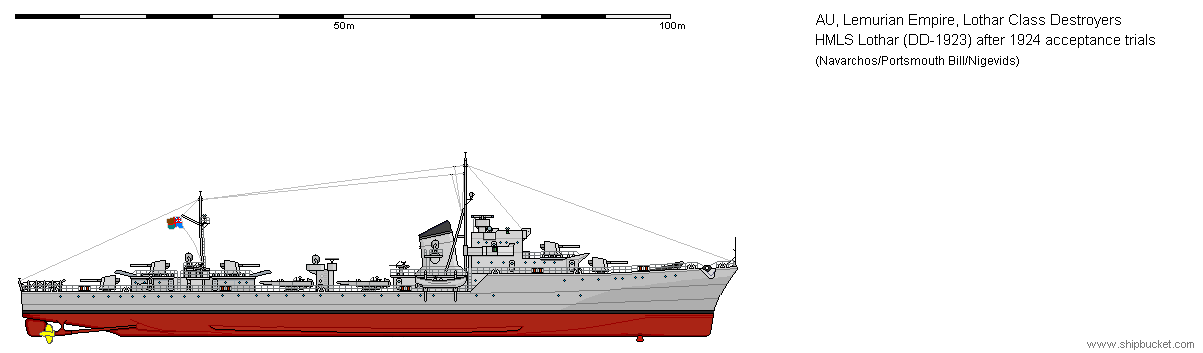
The range of weaponry trialed for the Lothar was large. 4"/45cal. 4"/50cal, 4.5"/45cal, 4.5"/50cal, 4.7"/45cal, 5.5"/45cal. The 4.7" was the Royal Navy's weapon of choice. But at this stage all of the weapons were low angle to about 45-50 degree elevation, almost useless for anti-aircraft work. Until enough quad 2 pounder mountings became available, the four single 2 pounder were the light AA weapons. A light open director was fitted for the main guns at the back of the bridge, while a torpedo director was fitted on the superstructure between the banks of torpedoes. The Lothar and first group of four production class vessels were fitted with triple torpedo tube mountings. After that the next four groups of four had quad torpedo mountings, the last group of four had quintuple (5) torpedo mountings. So which gun was chosen? Looking at the drawing gives a clue to either 4.5" or 4.7". For me it has to be the 4.5"/50cal weapon with 50 degree elevation. Range of 20,000 yards firing a 54 pound semi-armour piercing, and 50 pound high explosive shell, at 8-10 rounds per minute.
Originally these ships were thought to be big enough to provide their own flotilla leader, but the ships had not been designed for the extra staff and the building of the Diamond class provided the leaders needed for them. The class members completed 1933 to 1940 had a new 4.5"/50cal weapon with 80 degree elevation for true dual purpose anti-aircraft capabilities. They were replaced in the building queue by the Henri class.
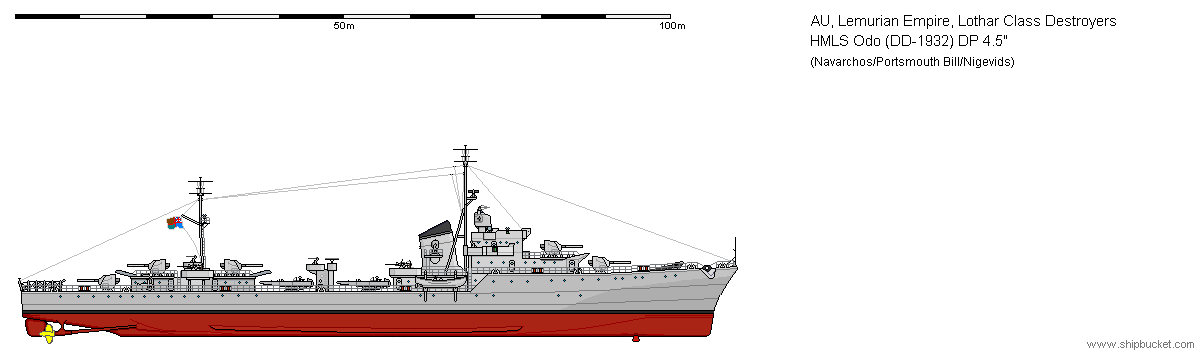
January 1944 and the Emerald and four Odo type were patrolling in the South China Sea. They were on the lookout for some Japanese cruisers that were trying to return to Japan. The radar is pinging and the operator yells "Contact!". He gives bearings and headings and then speed and direction of travel of the enemy as its track becomes apparent from the radar readouts. The Captain (D) aboard Emerald orders "Start the attack, send the order to the group". The group had practiced these maneuvers and knew the drill. The group went from 20 to 28 knots and were overhauling the enemy who looked like it was at 12-14 knots. The hope was to get within torpedo range, without being spotted, launch torpedoes and open fire so that the Japanese ship would be unaware of torpedoes in the water.
The group gets to 11,000 yards and the Captain orders make the signal "Launch!". The group turns parallel with the Japanese ship and one bank of torpedoes from each ship is launched - 24 torpedoes in the water from ahead to astern to try and enfilade anything the Japanese might do. Phase two is due to start, the order "light searchlights" is given and five searchlights turn night into day. "Myoko Class cruiser!", the identification is made as the 28 x 4.5" guns open fire, sweeping the decks of the cruiser, starting fires and knocking out equipment that the shells can penetrate. A lot of the big heavy cruiser is armoured to withstand the 4.5" being fired at it. The 'Pagoda' bridge is not one of those areas and a lot of hits are made that knock out the command and control sections. Keeping the Japanese command structure from making too many orders. The Myoko was now increasing speed but not making any course changes. Their general alert call was still trying to get the ship to red alert, when suddenly it no longer mattered. Three large mounds of water rose along the length of the Myoko, the big cruiser came to a stop in the water, its main guns still pointing fore and aft. The secondary 5", and torpedoes had been knocked out, the Myoko was toothless. The Captain ordered "fire our last bank of four torpedoes at the cruiser". Away they went and three more hits tore the Myoko apart. None of the five Lemurian ships received any damage.