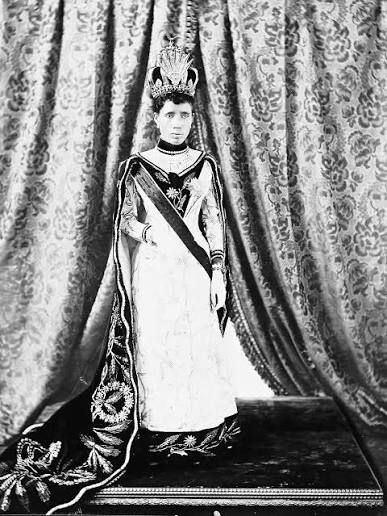
The Lemurian Navy could do with some more capital ships, but could not afford to build any more of the huge battleships that were currently under construction. While reverting to 12" guns may have seemed a bad move, the ships were to be used on the trade routes as the Germanic States heavy cruisers were getting too big for the light cruisers then being built. An enlarged Andrianerinerina with four inline turrets would be acceptable.
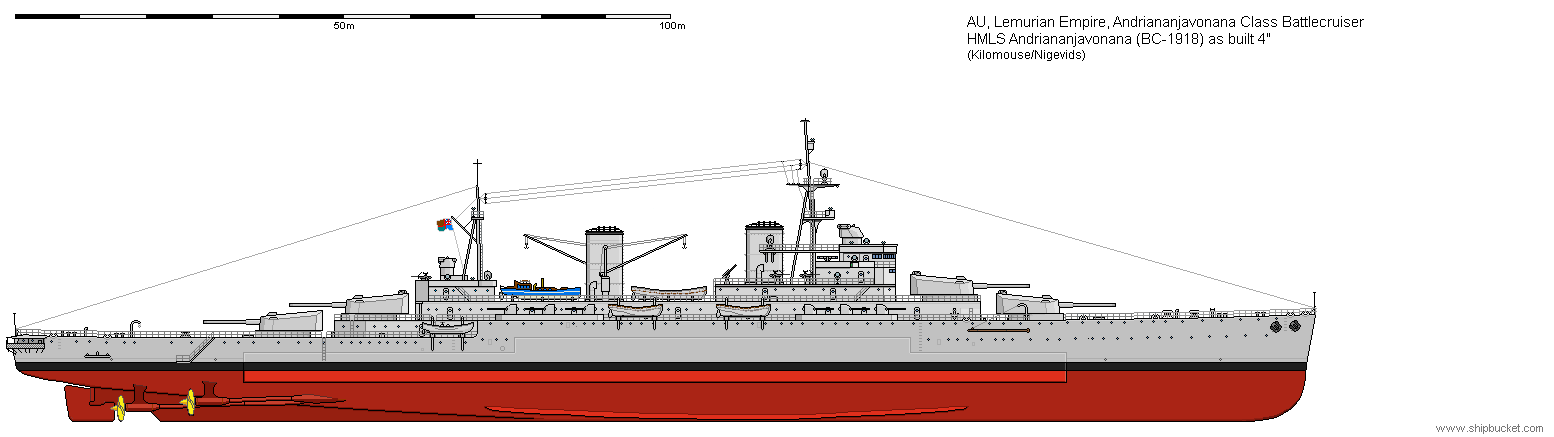
The base for this drawing was the Zealandian Forod-Waith Class light battlecruiser. I replaced the 10" with 12", replaced the lower hull. Expanded the upper deck and hull to take the bigger bridges and make more room for ships boats. This gave enough space for the twelve single 4", or eight single 5.5" (see drawing below). But funnily enough I went looking for what the complement for the ship should be and looked at the RN Indomitable Class battlecruiser, and found that I had done a similar drawing already. This drawing does have a lot more "Lemurian" features, I have used the generic cruiser bridge superstructure which I alter to suit each drawing. I take that sort of thing from the Germans whose cruisers, battlecruisers, and battleships all had similar bridge superstructures to make identification just that much harder.
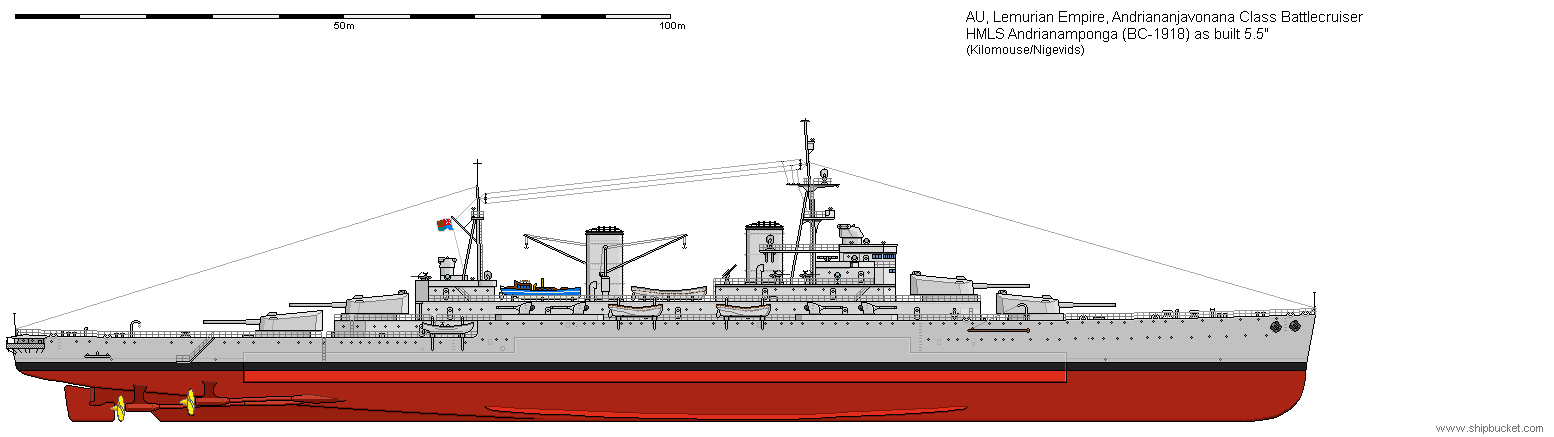
The extra drawing with the 5.5" is so that the ships match the King Ralambo which was being built at the same time with the 5.5" as the secondary armament. It would make sense for these ships to have the same gun.
The two ships were still going through their acceptance trials when the war came to an end. The two new ships made up Battlecruiser Squadron One and did so for all their careers. Long range patrol work was to be their lot between the wars. Lemuria had a large coast line to look after and the choke points, north and south, required ships of force to maintain order in the areas. No matter how hard they tried, the pirates of the Andaman and Nicobar Islands could never be wiped out. New nests seemed to breed and prey on the passing commerce that passed by their lairs. The two Andriananjavonana class ships spent a lot of time shelling the island groups trying to remove the pirate menace. But the pirates knew how far the warships guns could fire and their villages were out of range inland. The advent of the aircraft carrier did change that, and the two Karikala class went with the two Andriananjavonana class battlecruisers on their anti-piracy patrols.
The two ships went in for their rebuilding during 1938, they would return to the fleet, in mid 1940, having missed the early battles against the Tirpitz and in the South Atlantic against the Axis forces and the retaking of the Falkland Islands. The rebuilding was comprehensive and replaced virtually everything except the main armament.
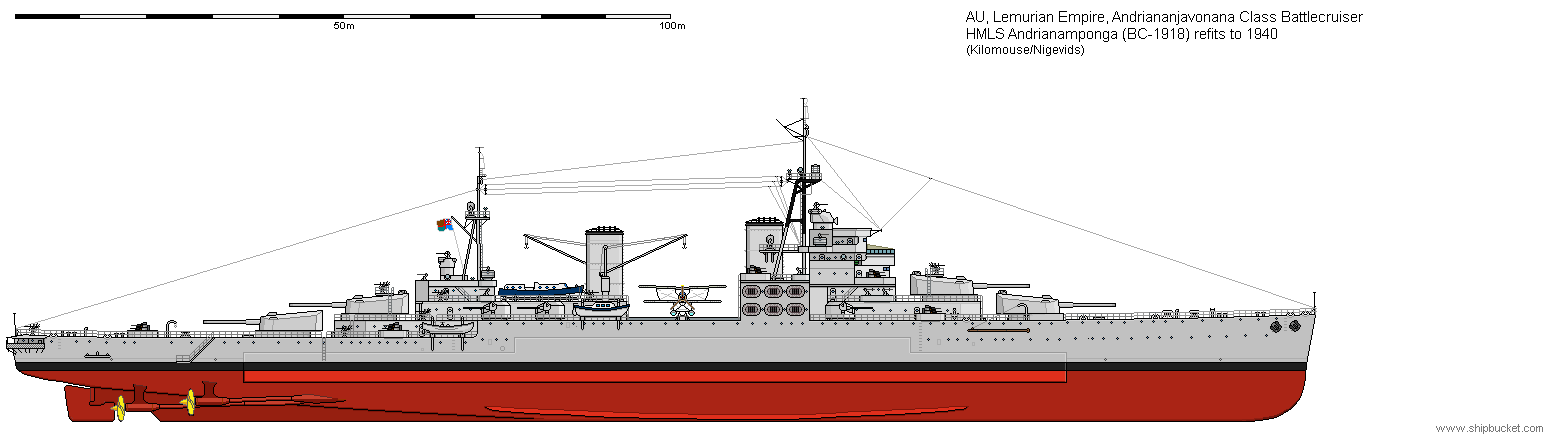
The upgraded super duper cruiser killers were armed for a new conflict. AA weaponry now sprouted from every where and radar predictors for the 2pd guns were in the spaces left. 20mm were fitted for 2-3 years then all of the 2pd and 20mm were replaced with 40mm. Some of the biggest changes was to the machinery and deck armour. A fresh set of machinery was fitted and while the deck was up for that a new armour deck 5" thick was fitted.
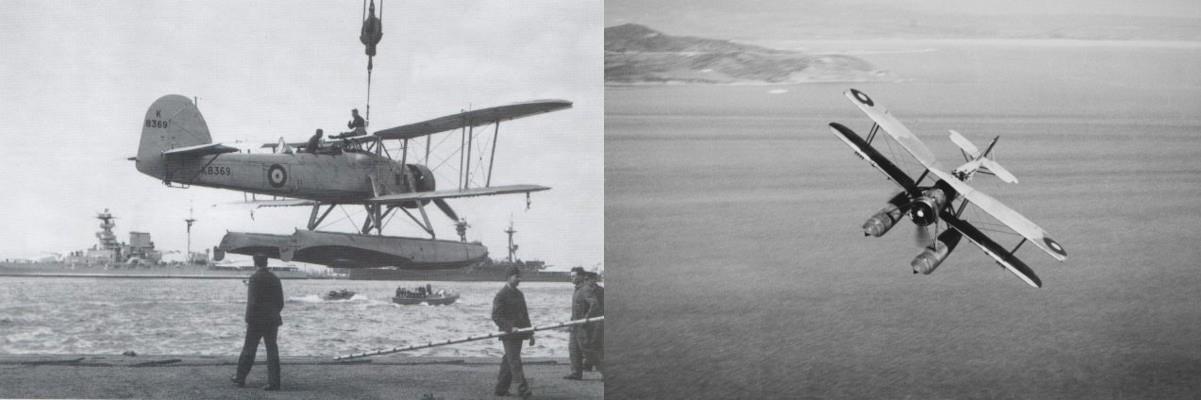
The Swordfish floatplane was the shipboard aircraft of choice and used up the generous stocks of obsolete aircraft replaced on the attack carriers.
June 1940 and the Andriananjavonana and Andrianamponga have joined the Fleet at Colombo. The King Ralambo finished its rebuild and the three ships became the First Battle Squadron with Admiral Kanaka in command. The Squadron was sent to the Mediterannean to join the Eastern Fleet under Admiral Cunningham, Admiral Kanaka became second in command. The Squadron dissolved on joining Admiral Cunningham, and the two battlecruisers became Squadron Flagships to groups of cruisers.
July 1940, the French surrender. This creates a multitude of problems, a lot of which surrounds what is to happen with the French warships now scattered all over the globe. Once those questions are solved, you then have to replace those ships in your order of battle. Suddenly having to find replacements for a carrier, half a dozen battleships and battlecruisers, a dozen odd cruisers, and some of the worlds best destroyers is not easy. The French had been covering the Western Med against interference from the Italians. Force H had to be created at Gibraltar to do that job. That is why most of the Lemurian forces go to the Eastern and Western Med forces to help stiffen the resistance against the Axis forces in the Med. That could be just Italy, or I can add Galicia, and or Spain. The total Axis Fleets in the Med could be quite formidable and the problem for the Allies is that they need a fleet at each end of the Med that can take on and beat the combined Axis fleet, however it is made up.
Malta can be a thorn in the side of the Axis forces, as long as it remains in Allied hands. The German Airborne Division only ever did the one drop on Crete to help take that Island. I could never understand why that unit was not used against Malta. Either before or after Crete. Once Malta was no longer available as a base to interdict supplies to North Africa then the Axis forces would have rolled through Egypt. 20/20 hindsight is a marvelous thing. I have wargamed, many times, trying out the Airborne Division against Malta. Nine out of ten times, Malta falls, and the German Africa Korps rolls on. That one event can tip the scales against the Allies.
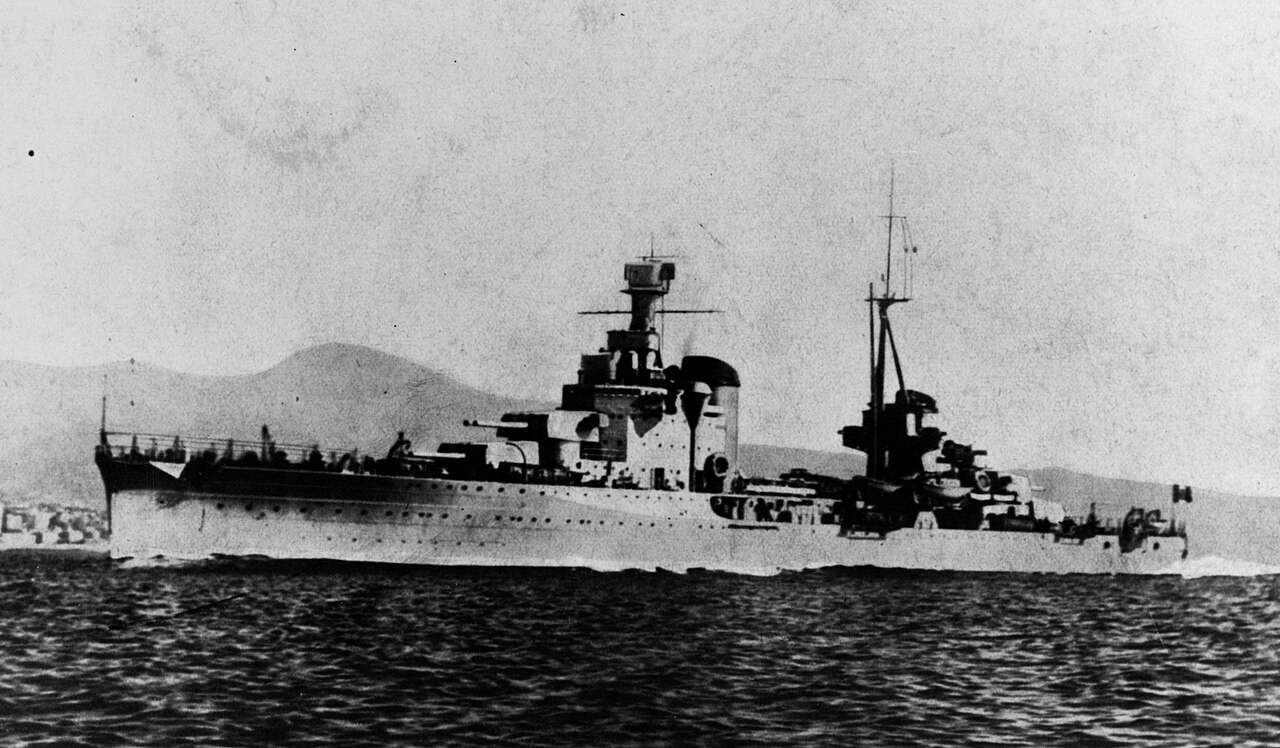
The Andrianamponga and four cruisers (Force J) are tasked with intercepting an Axis convoy taking troops and supplies to Tripoli. The convoy has cruisers and destroyers as its escort. Force J should be enough to wipe the convoy out. Force J has been steaming hard all night to reach the interception point at dawn. Dawn breaks and the horizon is clear. Where there should have been a dozen Axis ships was clear water. The Andrianamponga and another cruiser launch aircraft to see if they can locate the convoy. Just five minutes later the answer comes in, the convoy is still twenty miles to the north. The convoy speed must have been slowed. Admiral Kanaka, who is flying his flag in the Andrianamponga, for this mission, is now between the convoy and Tripoli. The spotters have given him the order of advance of the convoy and Admiral Kanaka gives his orders. The Andrianamponga and the heavy cruiser will take the two cruisers (one and two) while the three light cruisers (Leander-2 and Diana) will take the destroyers. The battle lasted barely an hour and most of that was clean up work. The two airborne floatplanes spotted for the Andrianamponga and the heavy cruiser, who made short work of their opponents. Those to ships then turned their guns and spotters onto the merchantmen which the 12" and 8" shells tore apart. The other cruisers had no trouble taking out the four destroyers. The Diana with its ten gun, high volume of fire proving effective in shredding two of them. Now the trick was to have the ships running hard for air cover before Axis aircraft could catch and dispatch them.
Italian heavy cruiser sunk by the 12" guns of the Andrianamponga.
Admiral Kanaka is on his bridge receiving reports from all directions from the battle just completed when he receives two reports from the Air Search radar teams. One report says 60 aircraft approaching from the south-west, the second report has another group of 40 aircraft coming from the east. It will be touch and go. Will the the aircraft from the east get there in time to save Admiral Kanaka's ships. Admiral Cunningham had sailed with his three carriers in support of Force J's operation. The forty Griffon fighters should be enough. So it proves. The faster fighters get their first and are able to intercept the Italian bombers just short of the ships. The Axis attack is broken up and withdraws taking losses. There was no fighter cover for the bombers. As soon as Force J had joined with the main fleet, both elements turned around and returned to Alexandria. Another star to add to Admiral Kanaka's reputation.
That was the highlight for the pair. The rest of their service was as AA guards for the fleet and its carriers. Returning to Lemuria after being used for repatriation duties, the ships joined the reserve fleet until 1947 when they were formally struck from the Navy List and sold for scrap.