The Prajadhipok class were the pinnacle of the Khmer big destroyers, that were really destroyer leaders, but not termed as such by the Khmer Navy. Laid down in batches of three, two groups had been completed by December 1941. Four of those made up part of the escort for the tanker convoy described below. A total of nine were completed and used mainly as leaders to the older classes of Khmer destroyers. Most of the size of the ships was used for the large powerplant installed to make the ships so fast. Most cruisers would like to have that much horsepower under the hood.
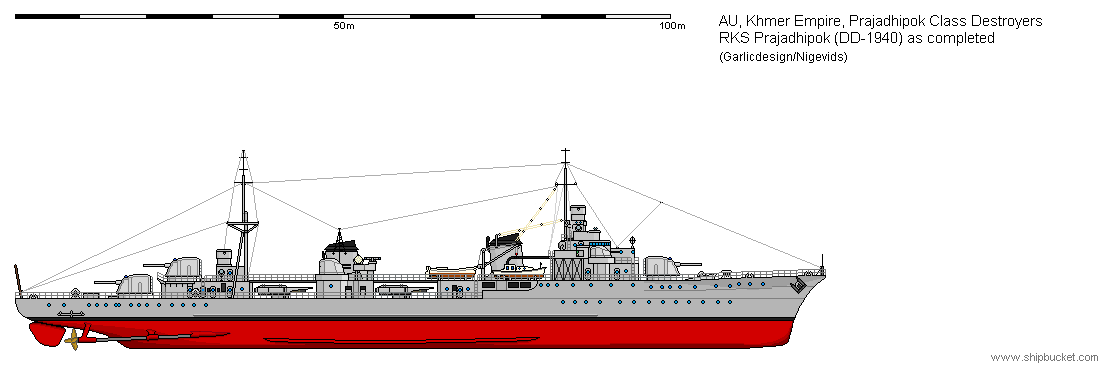
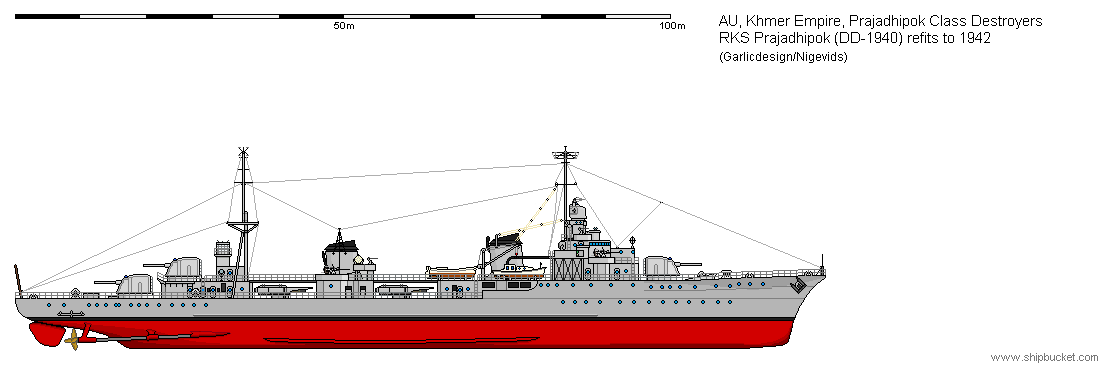
Being the latest and greatest destroyer class, these ships were some of the first to take advantage of the 'Lend/Lease' deal within the Allied members. It made sense to send these ships to Darwin for a refit to place the latest electronic and AA equipment aboard the ships. All nine had been through this refit by the beginning of 1943.
December 1st, 1941, the RKS Chlam (CVE), RKS Boromakot (CL) and four Prajadhipok class destroyers were tasked with escorting six tankers from Palembang to Nagasaki. The trip should take 14-15 days at an average 10 knot speed. Tensions in the area are high. The US sanctions against Japan are hurting the Japanese economy. The US has even told Khmer to stop supplying Japan with oil. Khmer cannot afford to do that and ignores the US demand. December 7th, and the Convoy Commodore onboard the Chlam receives a coded message advising of Japans attack on Pearl Harbour and who is now at war with whom. The convoy is just north of the US dominated Philippines and still days away from Japanese waters.
It was felt that the US forces at Cavite Bay were too weak to interfere with the convoy and that the US would leave a non-combatant force alone. It was the destroyers and submarines that would be the main threat. The US had no capital ships in Asia and only a couple of cruisers. On the US side, the Americans knew about the tanker convoy and would dearly like to stop it reaching Japan. To do so would mean attacking Khmer and bringing that nation into the war against the US. Was a short term gain enough to outweigh the long term pain of having another sizeable fleet against them after taking the huge losses at Pearl Harbour?
There was one other way the US could stop the oil delivery to Japan. Pay more for the oil than the Japanese and have it delivered to ports of US choice.
The Chlam and its convoy are ground zero for Khmer. Whatever decision is made will bring Khmer into the war. Delivering aid to an enemy of the US is not recommended. But neither is angering the Japanese by not delivering the oil. At this stage the Japanese have a tremendous advantage in men and material in Asia. To go against Japan would lead to Khmer having to fight a war against Japan that it could not win. To join the Allied nations would not help much. Australis and India were the nearest parts of the Commonwealth and they had committed the main part of their forces to the European War, in this case in the deserts of North Africa. It would take time for those troops to be extracted from Africa to assist in a new Asian theatre of war.
The High Command had literally just a few hours to make up their minds, and choose. The choice was made for them as Japanese troops attacked the Northern border of Khmer, the next morning, December 8th. Khmer was at war with Japan.
Orders are received to board and take the two Japanese tankers in the convoy (the other four are from Khmer). One is captured the other commits seppuku and scuttles itself. The five tankers turn toward Cavite in the Philippines and go to war stations. US destroyers from Cavite come out to help escort the tankers into port. They are quickly surveyed and sent off in convoy with US destroyers escorting them toward Honolulu. This track will keep them south of the track of the Japanese main fleet that should be passing hundreds of miles to the north. The other problem to avoid was any Japanese forces based in Rabaul. Those forces were fully engaged in the Solomon Island region taking as much as they could before they might encounter resistance.
The Khmer force was to return to Khmer and part of its orders was to attack any cripples or still whole ships escaping north from the Battle of the South China Sea. See RKS Chakraphat for a description of that battle.
The Chlam only had 18 aircraft for attack purposes. 12 Bombers and 6 Fighters. The fighters were launched in relays to try and locate the leftover forces. When a light cruiser and two destroyers were located, the 12 bombers were launched to attack them. The six ships altered course, to intercept the Japanese ships, if the bombers left them anything to intercept. The attack went in, sinking one destroyer, crippling the cruiser with only minor damage to the remaining destroyer which kept going north at high speed. The Boromakot and two destroyers were dispatched to sink the cruiser. This was achieved with only a few shell hits on the Boromakot, whose fifteen gun salvoes wiped out the Japanese ships remaining armament. The Prajadhipok torpedoed and sunk what was left. It was lucky the bombers put the Long Lance torpedoes out of action before the surface action commenced.
That was pretty much the high point of the classes war. Generally they were tied to the fleet as Squadron Leaders or half leader if one of the Flotilla cruisers was carrying Captain 'D'.
