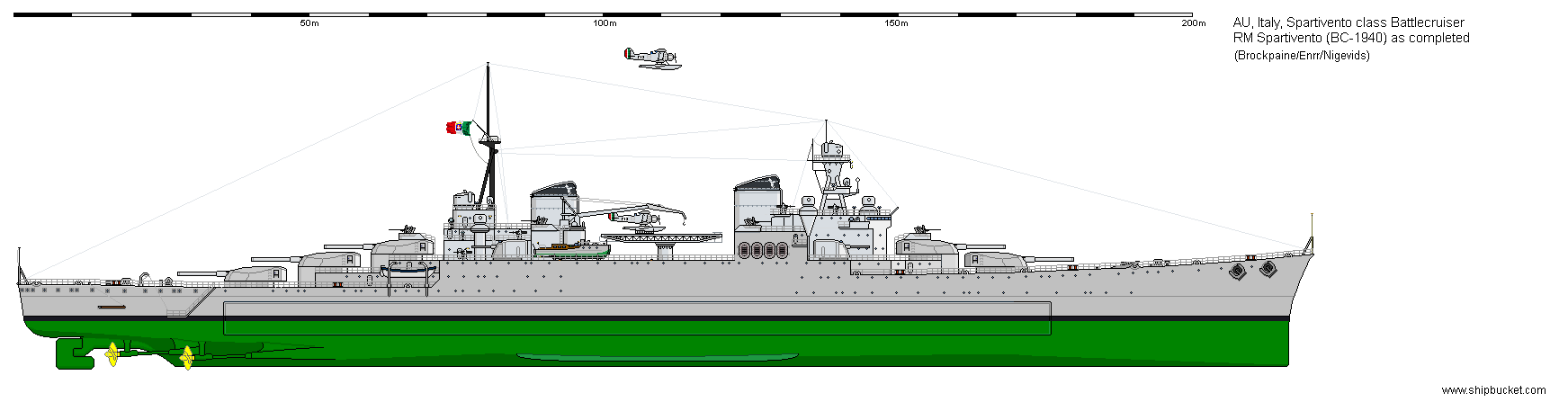
The Spartivento came about from the use made of cruiser sized vessels to guard and then shadow enemy shipping trying to pass through the straits they were guarding. The Italian Admiralty wanted a cruiser killer it could send into the various choke points in the Mediterranean to clear the way of any enemy scout units found. The vessel they envisaged was a fast battleship with enough firepower to overwhelm its opponent(s). To provide the armament for this ship, there was four triple 12" removed from the rebuilt Cavour etc WW1 battleships and one 12 triple turret recovered from the Da Vinci. All five turrets would be modernised to bring the guns to the same 12.6" bore as the earlier ships. An armament of 15x12.6" should be enough to resolve a battle with cruiser sized vessels. But, while the ship was armoured to fight cruisers, it was not armoured to take on full battle line vessels.
The Spartivento was in the middle of its acceptance trials when Italy was drawn into WW2 by its treaty with the Germanic States. The ship was immediately transferred to Taranto and the main Battlefleet where it would become the Flagship of the scouting forces which contained four Zara class cruisers.
The Spartivento and three of the scouting force cruisers are sent out ahead of the Vittorio Veneto, Cesare, and the rest of the battlefleet. It was hoped that the aircraft carrier Caraciolo, with the battle fleet, would offset the Allied advantage. The Spartivento and its cruiser force are sent down to the Island of Antikithira to stop any Allied force being sent round the north side of Crete and in behind the Italian forces. The scouting force was 35-40 miles ahead of the main fleet (2 hours steaming). To the west of Antikithira an Allied cruiser force of four ships was providing the same service for the Eastern Mediterranean fleet. Both forces had spotting aircraft up and found each other at roughly the same time. Both forces were reported as four cruisers. Reports were made to the appropriate Admirals. A couple of fighters from the carriers were sent from each side to discourage the others spotting aircraft. The Allied Griffons shot down all of the Italian aircraft including the fighters. This gave the Allied spotter aircraft a clear field to spot for their ships.
This advantage did not help. The Allied cruiser Admiral suddenly found his force was not facing four 'cruisers' but a battlecruiser and three heavy cruisers. His force had one 8" cruiser and three 6" cruisers. He was seriously outgunned. To make things worse the Griffons and spotters were forced to withdraw when four Ju88 fighter bombers turned up and overwhelmed the Allied aircraft. Unfortunately for the Italians they did not have a common radio channel with the 88's so they could not be used for spotting. The Italians did not need it. After only four salvoes the Allied cruiser York was in trouble and forced to withdraw. It eventually had to beach itself in Suda Bay on Crete and the wreck was used for target practice by Axis forces. The other three Allied cruisers covered the York's withdrawal with smoke and feint attacks. During one of the feints, the allied cruisers fired torpedoes. Only one lucky hit was scored on the Spartivento which withdrew back to Italy for six months of repairs.
The ship missed the rest of the battle which was a bit of a stalemate as the two Italian battleships exchanged gunfire with the three Allied (15") battleships. Both sides took hits, and once the Italian Admiral decided he could not force a win for his side with the ships available he withdrew. His ships being much faster than the Allied ships. One thing that emerged was that the Allied Griffon fighter was much superior to the Italian ones. This was remedied when the Germans transferred their Me109T fighters to the Italian Navy, these aircraft having been replaced by the next generation FW190A carrier aircraft. The Italians now had aircraft comparable to the Allied carrier aircraft. (The Italians were already producing a license built JU-87 for their carriers.)
Into 1941, which was to be a busy year for the Spartivento. It would cover convoys of Italian and German troops to North Africa, and was part of groups trying to intercept Allied convoys to Malta. On its convoy cover duties it had several actions with Allied warships. A force of cruisers and destroyers operating out of Malta intercepted the convoy Spartivento was covering which led to a hasty withdrawal of the remaining Allied ships once the Spartivento had sunk the two Allied cruisers from Malta. One Sirius Class and one Euphrates Class cruiser found out very quickly not to antagonise a cruiser killer like the Spartivento.
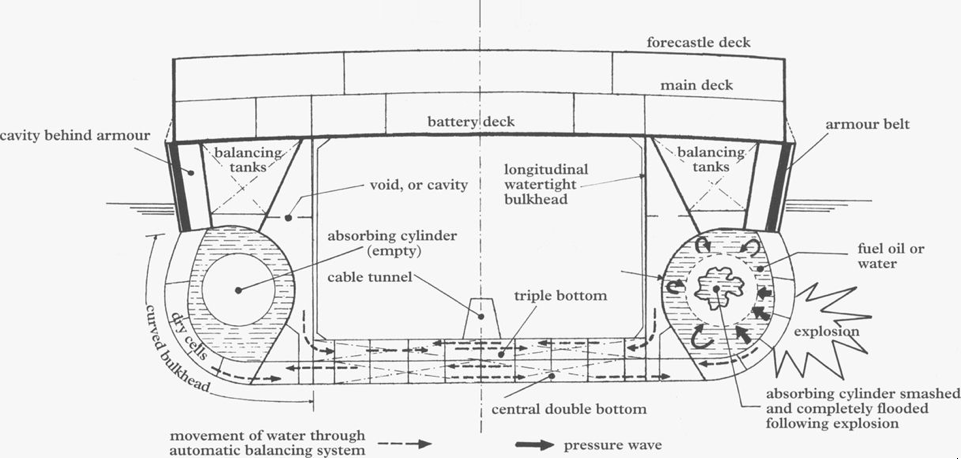
It was to be a submarine that would put paid to the career of the Spartivento. In trying to intercept an Allied convoy to Malta, the Spartivento and its cruiser force ran into an Allied submarine trap. Four submarines were waiting and the Spartivento and two light cruisers sprung the trap. All three ships received hits. Three hits on the Spartivento and one each on the light cruisers. One of the light cruisers was able to keep moving and escaped back to Italian waters and safety. The other CL was torpedoed in the engine room which stopped the ship dead in the water. The submarine was able to whistle up one of the other submarines nearby which hit the CL twice more which sunk it. The Spartivento had been built with the Pugliese underwater armour system. It had worked as advertised with the torpedo hit it received in the 1940 cruiser action. But this time the ship was hit three times. Two hits along the centre of the ship badly damaged it. It would have still been a going concern. It was the hit forward, where the Pugliese system ended, that did the damage. The explosion flashed through the damaged 'A' magazine and blew the bows off the ship. Traveling at 28 knots, the Spartivento tore itself apart with bulkhead after bulkhead succumbing to the pressure. Too much water in a ship and it tends to sink. The Spartivento sank by the bow its stern raising in the air till the weight of water in the ship drew it down to Davy Jones locker.