I have been quite critical in the past over the length of time it took the Navies of the World to figure out that an inline armament on a cruiser is far better than a 'broadside' cruiser where the majority of the armament is mounted on the sides of the ship in either casemates or deck mounted weapons. I suppose a bit of 20/20 hindsight may have come into play with my criticism. When looking at cruiser evolution from the turn of the 1890's into the 1900's, the biggest single change during this period was the change of motive power from triple-expansion engines to turbine engines. When you compare the deck clutter of the two types it is very easy to see why inline armaments were not possible until the advent of turbine machinery.
_IWM_Q_038114.jpg)
HMS Amethyst was the first ship bigger than a destroyer to be fitted with turbine machinery. Its three sisterships all had triple expansion machinery. The deck is still covered with clutter.
The Birmingham class, below, were the last of the broadside cruisers built for the Royal Navy. It was at this stage that the 'C' Types came into production with inline armaments.
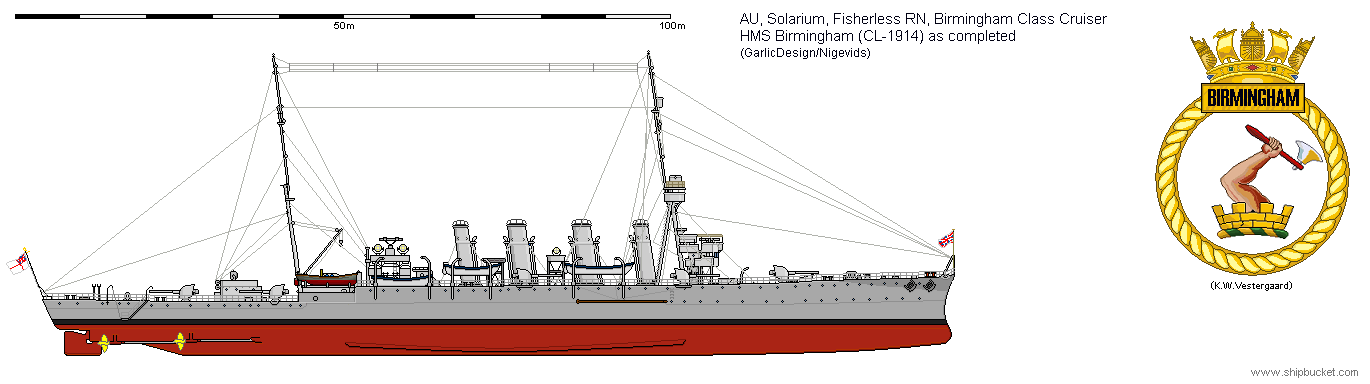
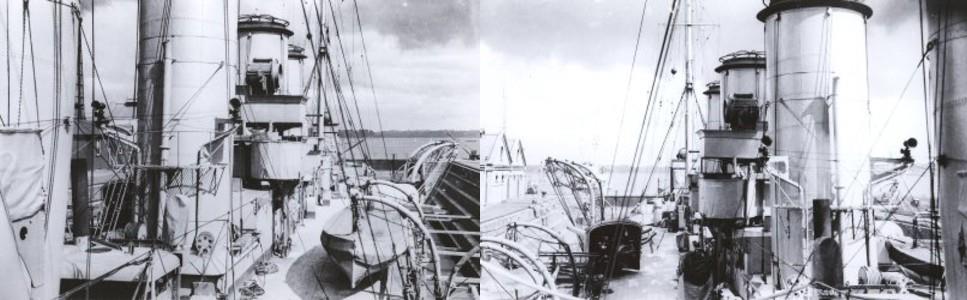
So the earliest that I figure the Royal Navy could have gone to inline armaments for cruisers was the 1912 Weymouth class. Their armament was eight single 6", one at each end and three down each side. A maximum broadside of five guns firing on either broadside. An inline cruiser with an armament of five single 6" would have the same broadside. A large saving in space, crew requirements, etc. The pros far outweigh any cons that anybody could think of. So why didn't the Royal Navy go to inline cruisers earlier than 1915. I think like all advancements, out of context with natural evolution, you require someone to point out the obvious. As happened with the Dreadnought. The Dreadnought doubled the number of 12" guns that could fire to either broadside compared to the earlier battleships. Without someone designing an inline cruiser earlier than expected then the progression of light cruisers would have proceeded.
My next gripe has to be about turrets on cruisers. The Royal Navy had a twin 6" on the Monmouth class armoured cruisers in 1903-04. It would have been an armoured turret, but something on a light cruiser would not have been as heavy or had the need for the same armour. The Birmingham (above) had two single 6", mounted side by side, for the bow mountings. It would have been far better for those guns to have been in a turret.
For me the Weymouth class of 1912 should have four 6" along the centerline with the fore turret being a twin for a total of six 6". Lets have a look at my 20/20 hindsight cruiser.
.png)
One thing that always amazed me was the number of funnels that were put on these ships during that 1900-1914 period. Four was common, even five or six was not unknown. My 20/20 ship with two funnels still looks the part of a pre-war light cruiser, but much cleaner.
I'm happy enough with how that turned out. Put my money where my mouth was. I would be happy to have a dozen of those rather than all the Town class that were built. Imagine what their WW2 rebuilds would be like.
12/04/2026
Looking through the evolution of the light cruiser, it was in the command and control functions that the biggest changes happened. Its no good having more guns if you can't hit your enemy with them. From 1916-17 the advent of AA guns also added to the cruisers armament and the controllers required for them. Local control was history. The changes to these Town class cruisers, enlarged the bridges to carry more sophisticated gunnery controllers and also allow for better commander areas for running cruiser squadrons and destroyer flotillas, a Captains berth with extra support staff required. The advances in engineering technology also increased the power from 35,000shp to 40,000shp giving another 2 knots of speed. The final versions, with their all turret armament, went to 45,000shp the speed going to 31 knots.
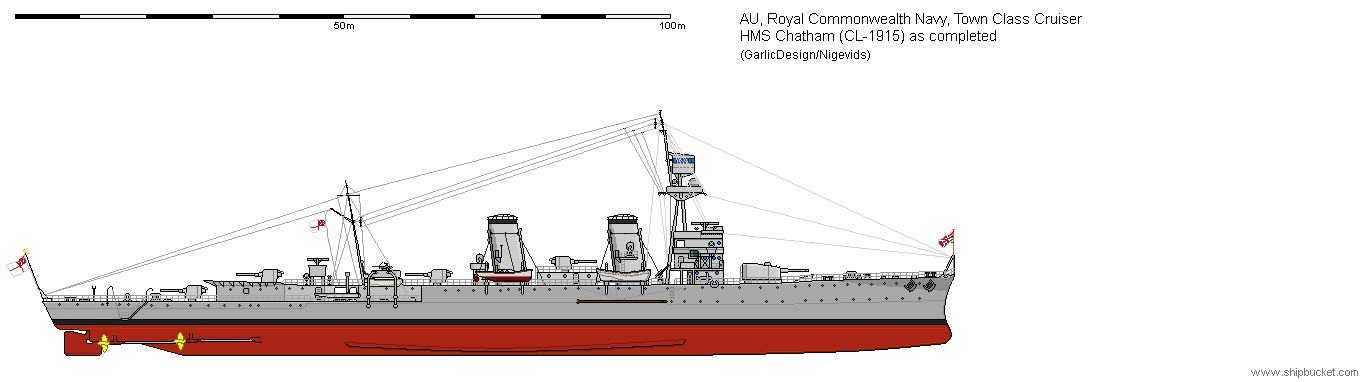
The move to an all turret armament made a large difference to the quality of the ships. It was a pity they were completed post Jutland and they did not get the chance to show their mettle against the German cruisers of the time. The new Battleships and Battlecruisers were in the design process, one of the new items was a new twin 6" with a high angle elevation for a 25,000 yard range. That was further than any of the 12" battleships then in existence. Three turrets were fitted, one forward, two aft. The ships never had their main armament altered they were too handy a cruiser as is. The main upgrades were to the heavy and light AA armaments. The three single 4" were replaced with two twins. The single 4" on the center desk house was replaced with a quad 2 pounder mounting.
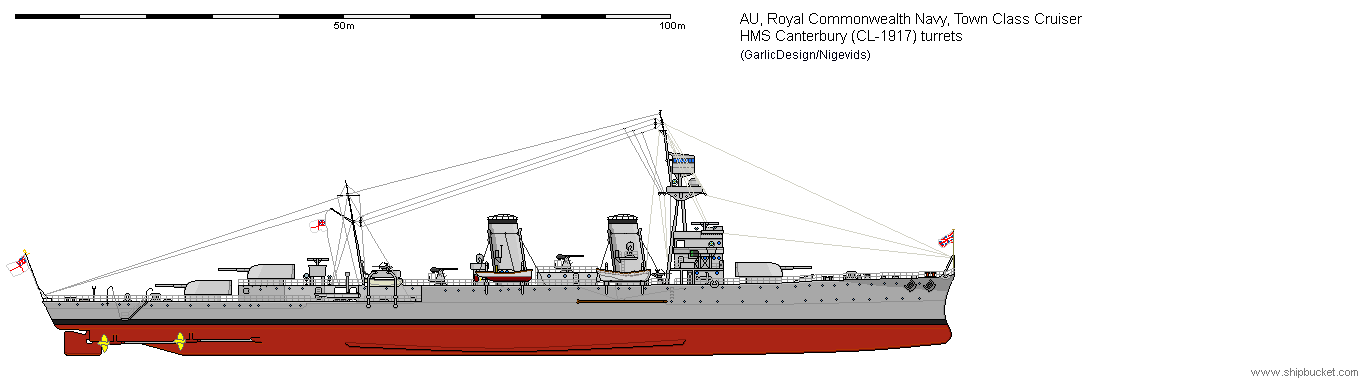
The successor to these ships were a four twin turret armed ship with a much enlarged armament and machinery package, see the E-F Class ships.
.PNG)
The final drawing in this series is a possible AA conversion of the original twin/single 6" ships. This replaced the single 6" with twin 4" and the center turret with a quad or octuple 2 pounder mounting. Only the new bridge structure ships received this upgrade as the older ships had already been deleted from the Navy list.
.jpg)