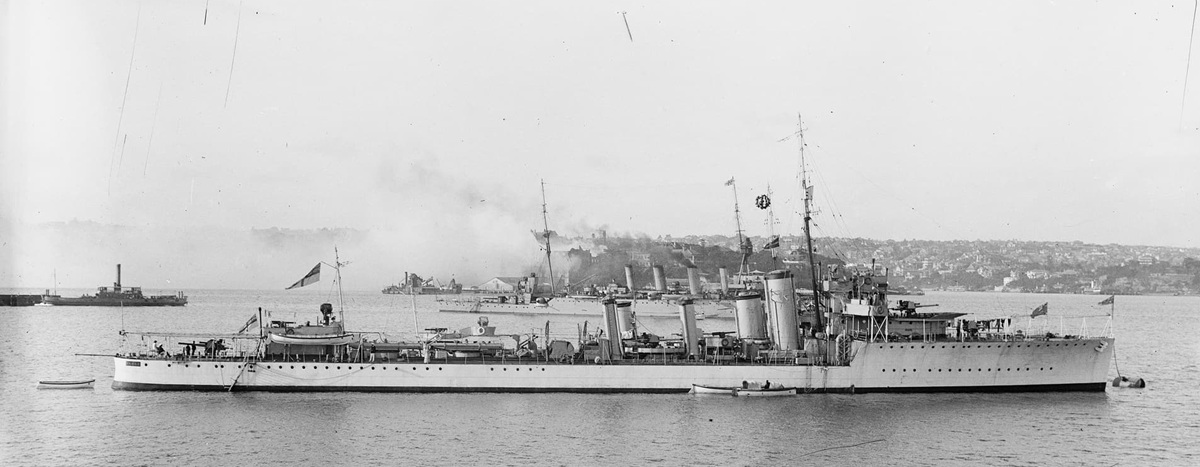
The four Phillippe class were laid down 1915 and completed 1917-18. They were designed and built as Squadron Leaders to the older destroyer flotillas. They would be commanded by a Captain 'D' who would be in command of anything from 6 to 20 destroyers as the 'Squadron'. To put that in perspective, a Captain of a cruiser would be in command of a crew of 400+, heavy cruiser 750+. The Captain 'D' on Phillippe in charge of 12 destroyers would have 1 x 125 + 12 x 90 = 1205 crew to be in charge of. Captain Vian was already a senior Captain 'D' when in charge of the Cossack that boarded the Altmark to rescue the prisoners from the ships captured by the Graf Spee. He ended the war a senior Admiral. Pretty good promotion prospects for the man. Worth a read, https://en.wikipedia.org/wiki/Philip_Vian
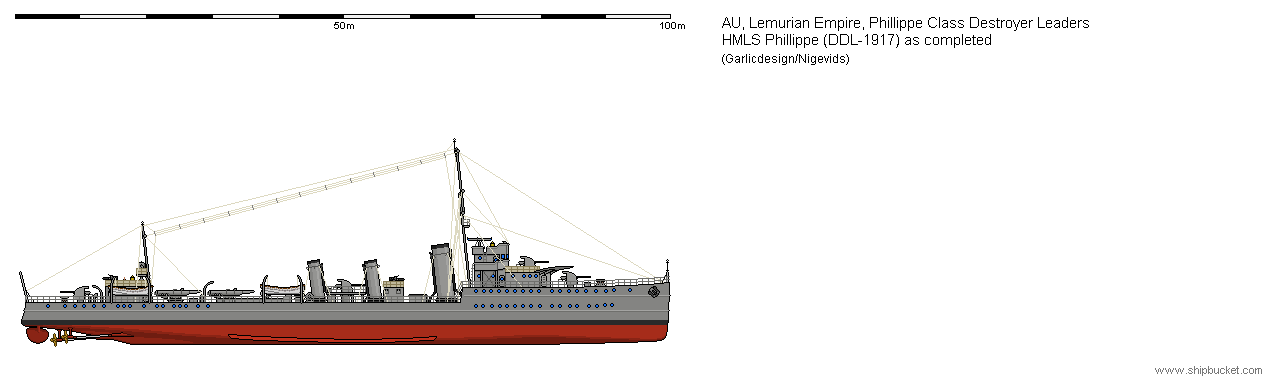
The first three completed took up stations as destroyer leaders to the three flotillas that surrounded the Lemurian Grand Fleet based in the Mediterranean. While the fourth ship was being completed it was taken in hand and converted to a minelayer. It had been decided the best way to keep the major Turkish ships out of the Mediterranean was to mine the entrance to the Dardanelles. The Meteor would undertake that duty. The Meteor would remain a minelayer throughout its service life, being joined by the Niravina in the 1920's.
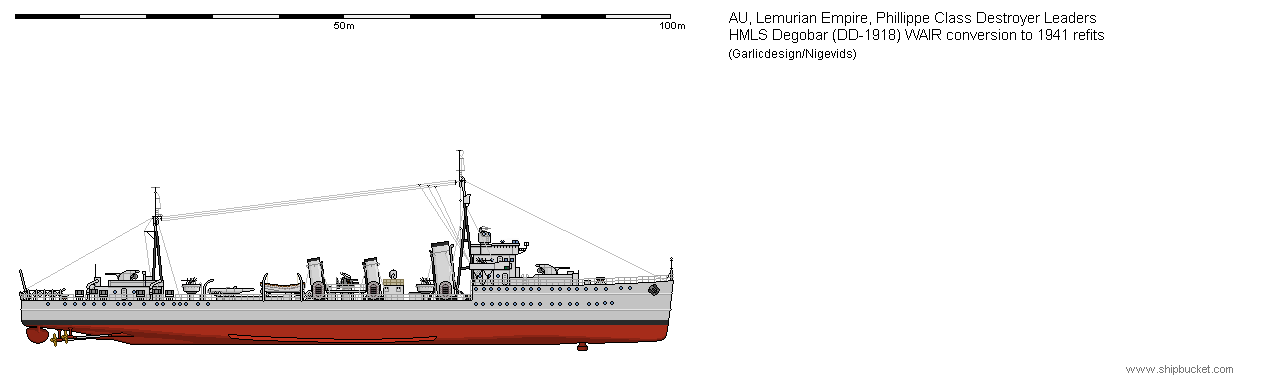
By the mid 1930's the three leaders were starting to show their age. The Royal Navy had started its 'WAIR' conversions which the Lemurian Navy liked the look of and applied it to the Phillippe class destroyers. The conversion did remove the tag 'Leader' from their titles to become just 'Destroyers'.
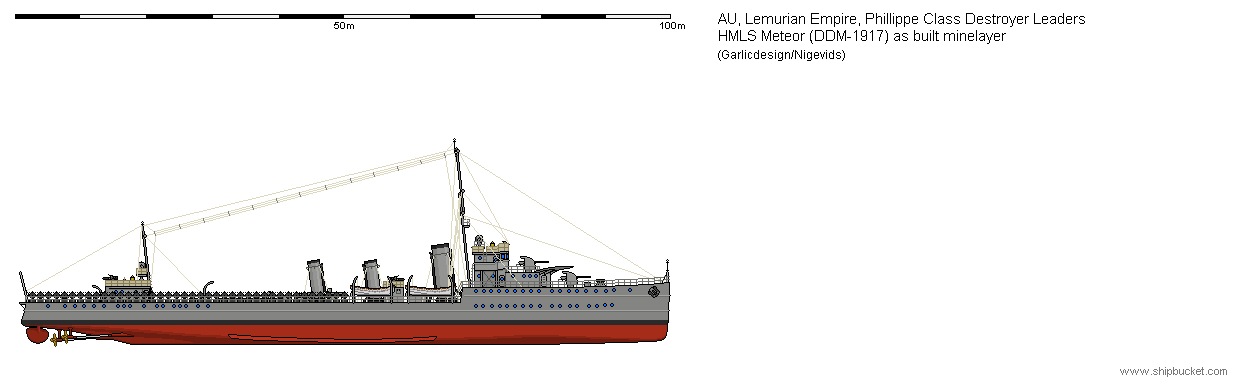
Niravina and Meteor were mining the Mozambique Channel when Niravina fell victim to the Tirpitz and the aftermath Battle of the Mozambique Channel. On completion of the laying of the home minefields, the Meteor was transferred to the Mediterranean. Meteor was the first of the class to be lost. It fell foul of one of its own mines when mining the approaches to Benghazi. One of the mines twisted on its launcher, broke a horn and the ship disappeared, lighting up the area and with a boom that could be heard many miles away.
The Phillippe itself was the only other loss to the class. It was running escort to small groups of ships from Southern African ports to Sierra Leone where they would join with other groups to form a convoy going to UK ports. The German Admiral Scheer was in the South Atlantic on its way to passing into the Indian Ocean which it felt would be lightly guarded. First light and the Scheer is at red alert, the lookouts start sounding off, "Clear to the North", "Clear to the West", "Clear to the South", "Contact to the East". The Kapitan's order is short, "Launch aircraft!". Reports coming say four merchantmen and one escort. The hunt is on. The Commander on the Phillippe orders the merchantmen to turn south and make a run for the South African coast and some air cover while the Phillippe will try to buy some time by attacking the Scheer. The Kapitan on Scheer can see what is happening and knows he needs to take out the escort quickly. With his spotter airborne and in position to record the fall of shot, Scheer opens fire. Maneuvering at 34 knots the Phillippe is not going to be easy to hit, but it will only take one or two 12" hits to change that. The Phillippe is trying to get into the 15-16,000 yard range where its own guns can hit the Scheer and where a possible torpedo launch could take place. The Phillippe steadies to open fire and hits the Scheer twice with its first two salvoes. Neither hit does more than scratch the paintwork. In return the Phillippe is now also in range of the Scheers 5" secondary armament. These faster firing guns start to hit the Phillippe when, bam, one 12" hit, the Phillippe swings wildly to one side and fires its torpedoes. The spotter aircraft warns the Scheer of torpedoes in the water and Scheer maneuvers to avoid the two torpedoes that had been Philippe's only hope of saving the merchantmen. The Phillippe was already slowing when another two 12" hits arrived and suddenly the ship was dead in the water.
The Scheer went after the merchantmen and sank all four. A clean sweep for the Scheer. That is how Goebels put it too, " German cruiser wipes out Allied convoy". Not unsurprisingly that made the Scheer public enemy number one. The Scheer received orders to return to Germany. While passing through the North Atlantic heading for the Denmark Strait the Scheer ran into the French Force M. The Allies had their revenge.