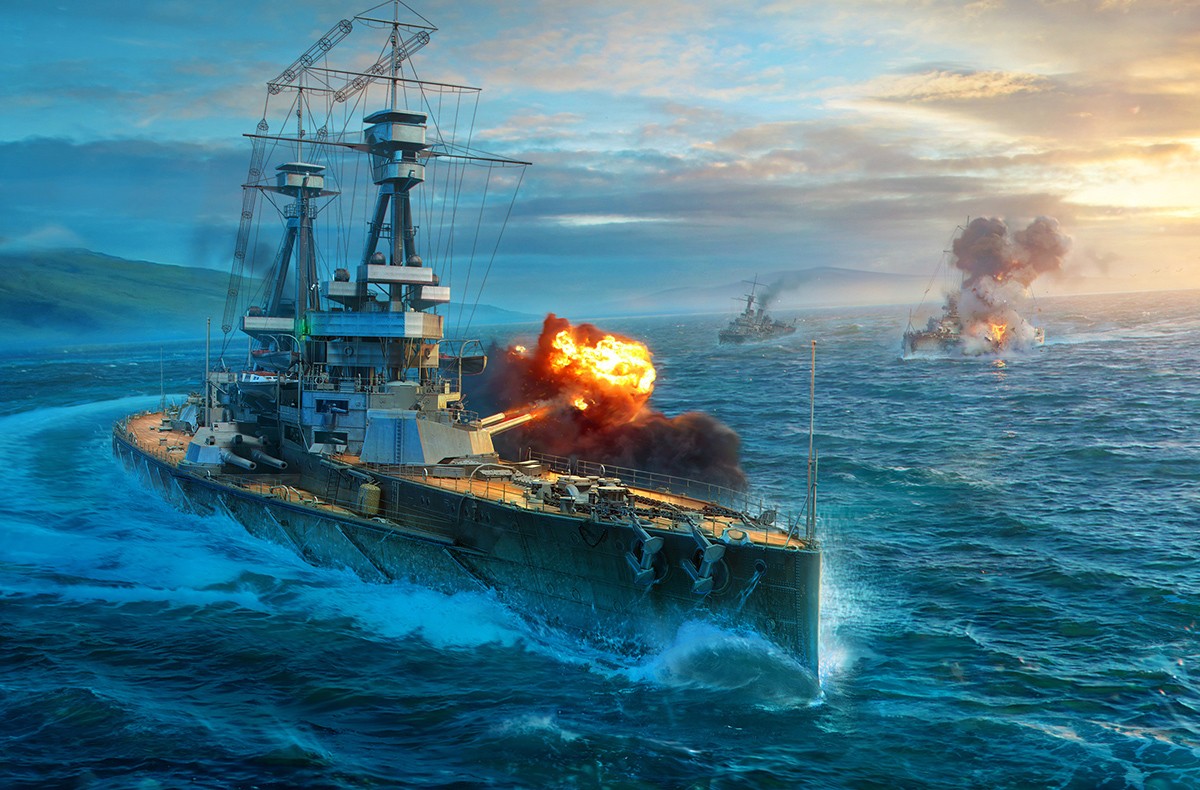
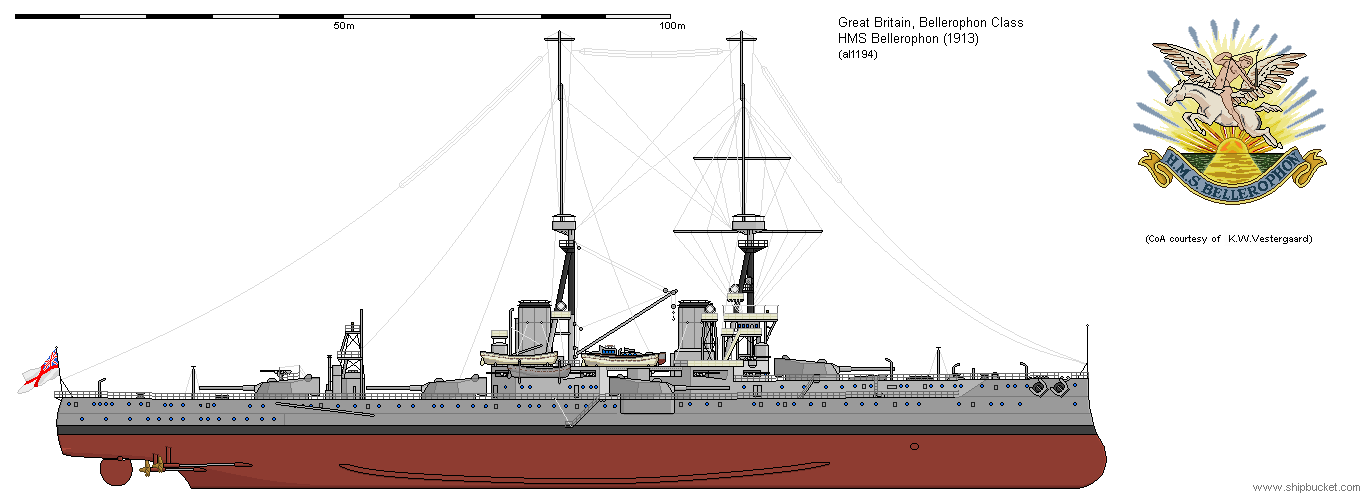
The Lemurian Navy received the plans for the follow up to Dreadnought, the Bellerophon class, in 1906. Royal Navy request "Build as many as you can". Well the Lemurian designers looked at the plans they had been given and thought, but did not say out loud, 'Rubbish'. The awkward wing turret design. No matter where your enemy was you could not fire all your main weapons at them. Something needed to be done. Beside, Lemuria did not want to have to spend any extra money on a wasted turret. The Americans first Dreadnoughts were under construction with superimposed turrets fore and aft. It was felt that too much alteration of the design would be required to achieve that. A better balance would be to remove the wing turrets and replace them with a 6" secondary armament in casemates. But when I did the drawing, I couldn't help myself and I did it with superimposed turrets fore and aft. That would make the ships a bit longer, but would give them a better anti-torpedoboat armament.
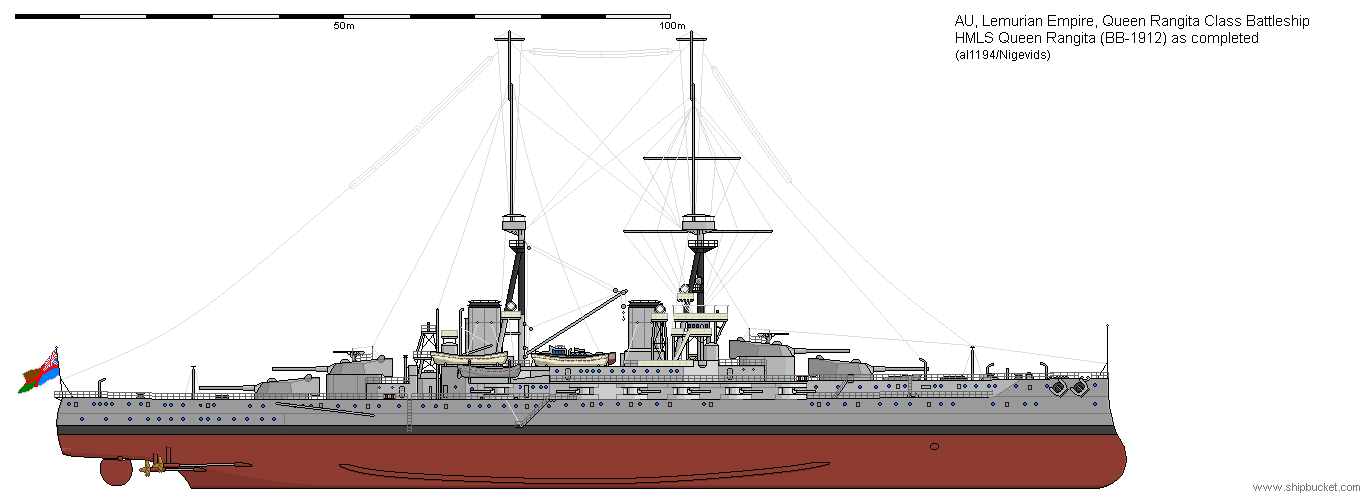
The final design showed a handsome two funneled ship with a pleasing slope from bow to the superimposed turrets. The length overall only increased a few feet (nine) going from three inline turrets to four.
The new design being built by the Lemurians was sent off to the Royal Navy who were mildly impressed and passed the changes on to its next class of three for the Neptune/Colossus type. The Royal Navy went from one Dreadnought to seven in the blink of an eye. In the same period Germany built four. That was the closest the Germans ever got. By 1914 Lemuria had completed two dreadnoughts and a Dreadnought cruiser. Other Dominions also completed more Dreadnoughts. Without any assistance, the Germans were always further and further behind the eight ball.
The Queen Rangita was Fleet Flagship till the arrival of the Lemurian Orion class battleship in 1915. The Fleet was based on Colombo at the mouth of the Donbon River, the outflow of the Donbon Lake.
As at 1914 the Fleet disposition was:
One Armoured Cruiser at Trincomalee to cover the Palk Strait.
One Armoured Cruiser at Hazamara to cover the Mozambique Channel.
Two Queen Rangita, one semi-Dreadnought, two pre-Dreadnoughts at Colombo.
Various cruisers and coast defence ships (old) around the Indian Ocean coast of Lemuria for local patrols.
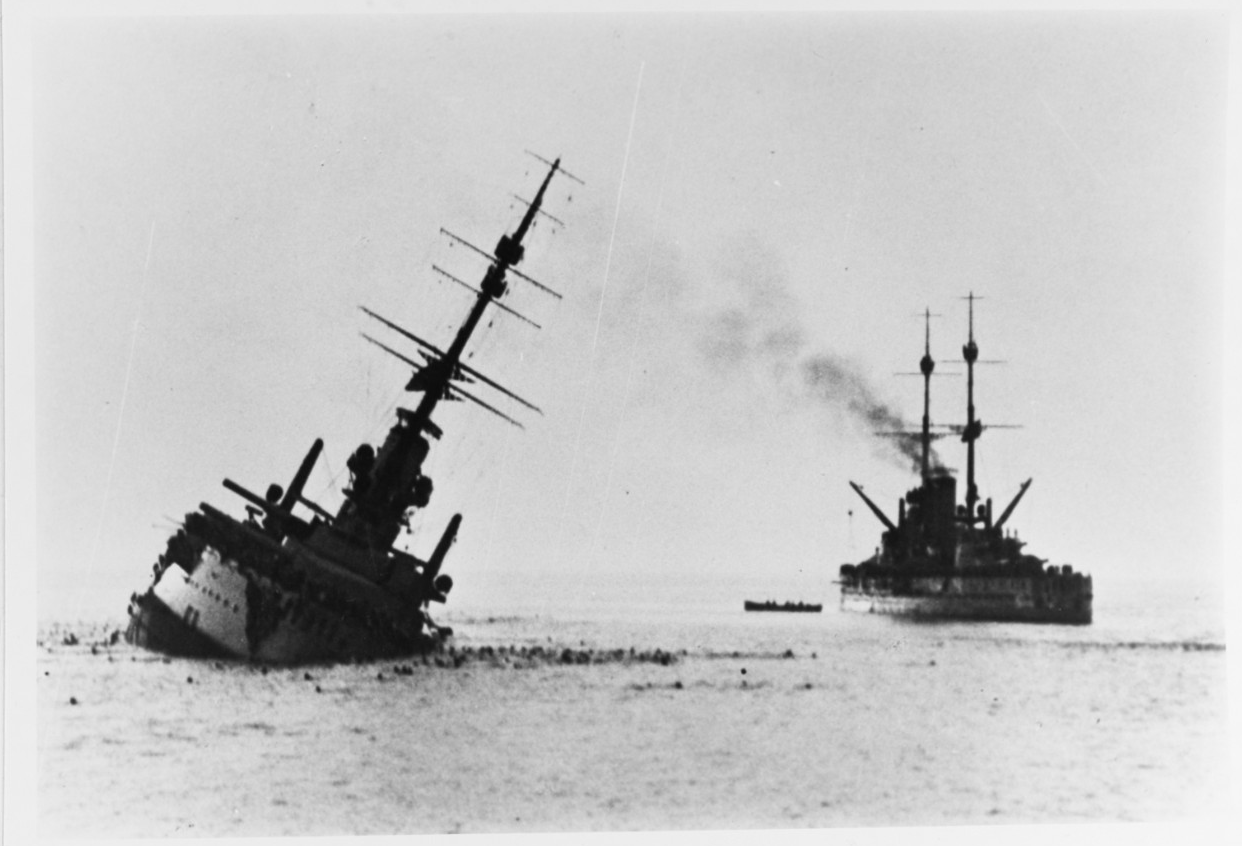
With the resolution of the ships of the German Overseas Fleet (Von Spee), this allowed Lemuria to transfer its main fleet units into the Mediterranean and allow the Royal Navy units to be sent to the Grand Fleet. The two Queen Rangita class joined the Italian Dreadnoughts in blockading the Austro-Hungarian Fleet in the Adriatic. Both sides laid major minefields to try and catch the others Capital ships out. Only the Austrians lost a ship when the Szent Istvan struck one in 1918. The underwater protection was sub-standard (like most early Dreadnoughts) and the ship continued to let water in till it capsized. (In real life the St-Isy was torpedoed, same result).
The two ships survived World War One in excellent condition. Sitting around at anchor in Taranto did not wear out the ships. What it did do was to allow the Lemurian ships to plot down to the last inch where the Italian Fleet units and Battleship moorings were. That same information was passed to Admiral Cunningham in 1940 and allowed the Mediterranean Fleet to destroy the Italian Fleet in harbour. When you know exactly where your enemy is going to be, poking holes in them is so much easier.
The armoured cruisers guarding the straits had gone to the breakers yards and the two Queen Rangita took their places. They would be the pointy end of the interception squadron. The Washington Treaty passed Lemuria by as the number of battleships were too few to worry the Treaty enforcers. But having the two Queen Rangita class in their inventory would allow the Lemurians the chance to build new replacements in the early 1930's. As it turned out the Japanese abrogated the treatys in 1930 and the gloves were off anyway. This gave the two Queen Rangita class ships the chance to exist past the early 1930's when they would normally expect to be removed and scrapped. All the countries were looking to extend the life of older capital ships to fill lesser roles to allow the modern ships to provide the Fleet nucleus. How much work was to be done on the old ships for their 'modern' role was what concerned Lemuria.
.png)
The idea was to not only use them as guard ships, but also as training ships. To this end the battery 6" would be removed and plated in. An assortment of lesser guns would be fitted for training purposes. The ships main role as guardship would still be covered by the main 12" gun armament. Thought was given to fitting aircraft handling facilities but this idea was discarded as the space was just not available. As it turned out a small aircraft carrier joined the Mozambique and Palk intervention squadrons and solved the problem of aircraft.
One of the most visible changes is the removal of the very tall masts of the earlier version. As wireless telegraphy improved the need for those very high masts was also removed. The replacement bridge superstructure enhanced the command and control functions of the ships. A main gun director on the bridge with an AA director mounted behind it. On the aft superstructure a simple 'follow me' director was mounted that could control the main guns if the main director was incapacitated. The last pair of directors mounted on the bridge, just ahead of the fore 4" were for the submerged torpedo tubes. These had been kept for training purposes.
I am dreaming up a battle where a Germanic States raider tries to force through the Mozambique Channel and into the inner African Ocean where there would be plenty of shipping and very few escorts, but the Queen Rangita says "You shall not pass!". Working on it.