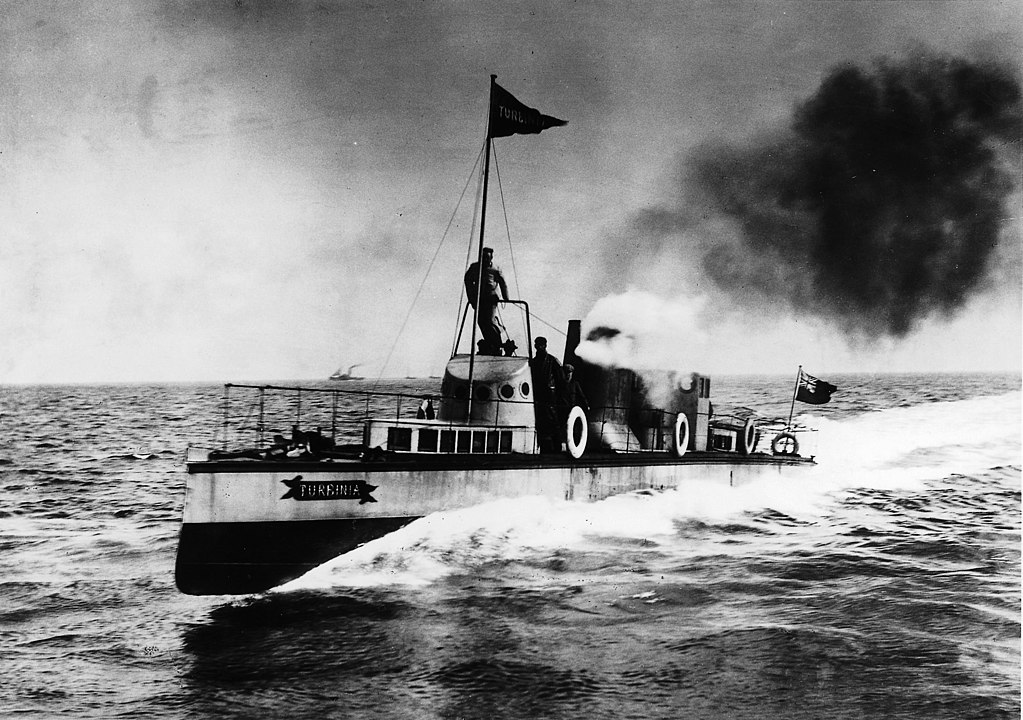
The Turbinia was commissioned by Charles Parsons as a test bed for his steam turbine invention. Turbinia was built in 1894 and started trials, not only with the turbine engine but also propeller configurations, from the number of blades to the number of shafts. One trial had 9 shafts! 1897 Spithead review, and with the whole world watching, the Turbinia raced down between the lines of battleships at over 34 knots, an unbelievable speed for a ship of its size. The debate started, turbine or triple expansion? Turbine won. It didn't win easily and the hidebound navies that were slow to change got left behind. All of the British Dreadnoughts were turbine driven and benefited from it. Easier to get to speed and then maintain that speed.
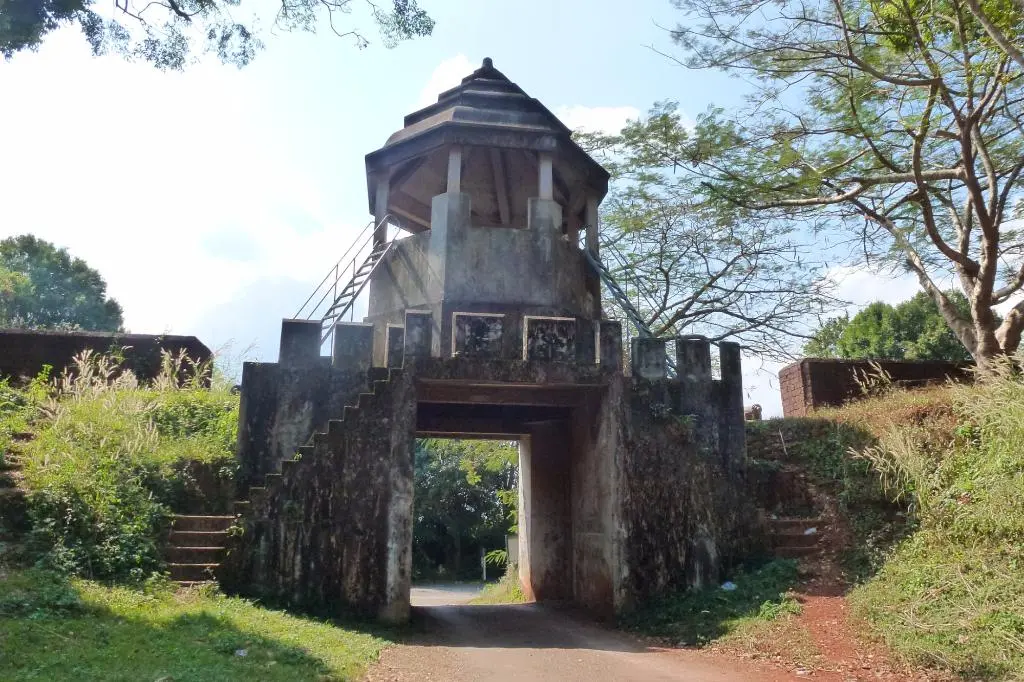
Khmer was slow with its battleships not getting turbines till 1911, the cruisers and destroyers were not much better, in 1910. The 1910 destroyers and cruisers had been test beds for the worlds turbine manufacturers. US, UK, France, Italy all were commissioned to produce turbines to place in the new ships. Lots of money changed hands as the manufacturers tried to improve their engines chances of picking up the lucrative Khmer deal. The French had the inside track and the Rateau/Alstom turbines were given the nod and would power Khmer ships for the next 30 years. The first few sets were sent from France while a dual venture company was set up to manufacture the R/A turbines locally under license. Turbines were also used to produce power from dams on the mighty rivers of Khmer.
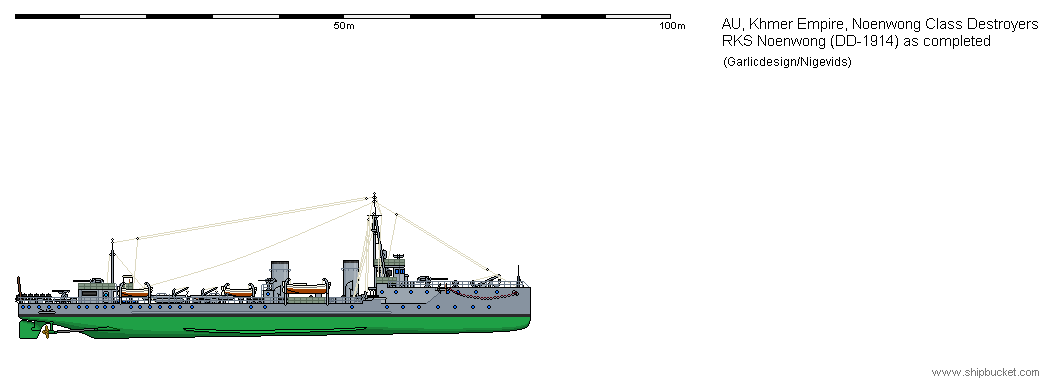
The original versions had two single 4" fore and aft with two 1910 model 25mm beside the aft funnel. That was the guns. Two twin 18" sets of torpedoes were there to inflict damage on bigger ships. The drawing shows the class in 1917-18 with a 2.6" or 3" AA gun aft and a rack of depth charges. Of the 18 completed between 1914 and 1917, eight were sent to the Mediterannean as part of Khmer's commitment to the war. Two were lost when their ships ran into a new minefield, struck mines and were sunk. Three of the ships shared in the sinking of a U-boat in 1917. The class were sent to the Med at three monthly intervals as replacements with those being replaced returning home. That way all of the class got some war experience.
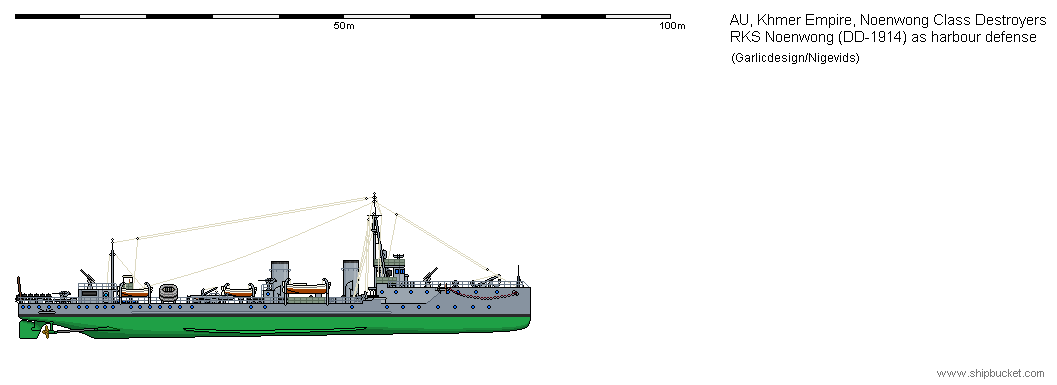
By 1940 there were only four left. One at each of the major ports as harbour defense and local training ships. The major change was the replacement of the 4" with later model 3" AA, and the replacement of the aft AA gun with another, (now 1928 model) 25mm. The torpedo tubes were reduced to one pair. The four ships fought valiantly against the Japanese attackers during the 1942 attacks with two being damaged to a state where they were written off and scrapped. The remaining pair served through till 1947 when they were removed from the navy list and scrapped.
This shows the length of service that Khmer ships were expected to attain. Money was tight and every ship had the last bit of service wrung out of it before they were deemed excess to requirements.