The group of five Cargo Liners running for the Lemurian Mail Service, servicing a wide area from Capetown to the south and Singapore in the north, working down both sides of the Lemurian continent. They were good sized ships with reasonable speed, and having five of them meant that they could keep a good schedule round their routes. World War Two intervened and the Melaky was sunk on its way from Capetown to Hazamara, by the Tirpitz, which was then sunk by Lemurian forces. (see BC Andrianerinerina for battle details)
The other four ships dropped the Capetown part of the run in 1940 when long range U-boats started operating in the South Atlantic. 1941 and calls were made for the Navy for more carriers to be sourced for the Fleet. The Royal Navy had just had its first escort carrier operations with the HMS Audacity. Escort carriers were suddenly being built in large numbers by the Major Powers. The Lemurian Navy looked for suitable ships for conversion and chose the four Sakaraha class cargo liners. It took two and a half years for the four Lemurian ships to be converted and join the fleet. The Sakaraha joined in October 1943 and the rest had been completed by June 1944.
The Sakaraha was used to escort the Lemurian troop convoys to Great Britain in preparation for the D-Day landings. Two such voyages were made, with the end of the second the Sakaraha was held in Britain for Atlantic convoy duty bringing reinforcements from the United States to Europe. It remained in this duty to the end of the war in Europe when the ship was used on repatriation duties, 'Bringing the boys home'.
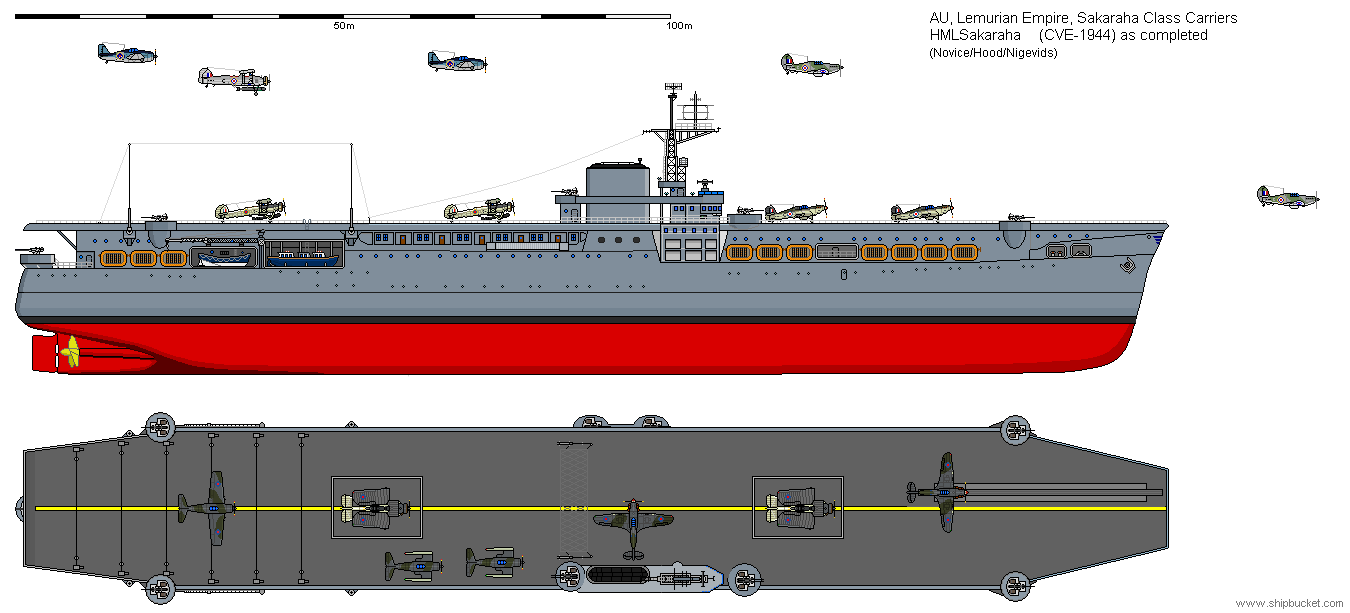
The other three ships operated in the Indian Ocean and Pacific Ocean theaters. With the long range U-boats still being active one ship, the Chera, was used to provide extra ASW aircraft to the entrance to the Mozambique Channel. The Karikala was still doing this along with its training duties which the Chera now assisted with. The Chera stayed with this duty till the end of the war. The two ships had sunk three U-boats and assisted surface forces with two more. They had done their duty.
The final pair, Atsimo, and Andrefana, operated as ferry carriers and escorts to the Fleet train in support of the Commonwealth Fleet operating in the South China Sea and then to the north toward Okinawa and Japan.
The four ships were all returned to mercantile service after the war. Being rebuilt into their cargo liner configurations.