I am using recycled Commonwealth drawings for Lemuria. Most are heavily modified to create new ships. The King Ralambo class is the one I have done the least work on, just modified the hull. The reason was easy, that ship was a rebuilt Renown class that would never have made it into my Royal Navy as it was replaced by the Barfleur and Majestic classes. Which made it a good fit for the Lemurian Navy as a modified Queen Elizabeth type which the Royal Navy DID build where the Lemurian Navy did not follow the RN triple 15" ships until they built the King Andriamanelo class. The Ambohimanga follows that trend being a rebuilt Apollo class.
The Lemurian Navy had plenty of tonnage to build whatever type of ships they wanted. What they didn't have was the budget. Like a lot of countries, the First World War near bankrupted Lemuria, just completing the ships they had on the near complete list kept the Navy busy for years after wars end. Many that were nowhere near complete were scrapped on the stocks, after being stripped of any useful equipment that may have already been delivered. New ships would need to be built in the future and any saving would be a blessing for the Navy.
1928 and the plans were being finalised for Lemuria's first purpose built aircraft carrier. The previous three had all been conversions of existing ships. The designers had certainly learnt from 5-6 years of running the carriers they did have. The storm damage to the Queen Rafohy was factored in with the first enclosed bow for Lemuria. The previous three hulls had just had a hangar and flight deck plonked on top. The hulls had a lot of existing factors not required by the purpose built ship. The purpose built ship had the hull and hangar wall integrated. This made it easier to fit the aircraft hangar into position. Despite being lighter than the Queen Rafohy, the Ambohimanga carried more aircraft, 76 to 64. This applied around the world with comparable sized carriers in conversions and purpose built. Examples: Lexington and Essex, Akagi and Zuikaku.
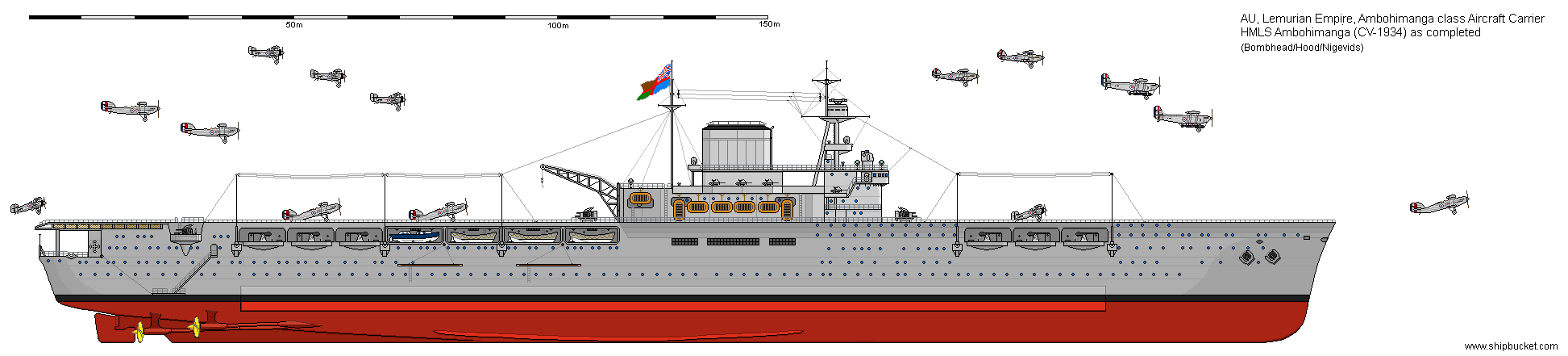
The Ambohimanga was just what Lemuria needed, a second carrier, so that they could train the fleet against each other, and learn how to use the aircraft in the best way possible. The last of the biplane aircraft were on the Ambohimanga when it joined the fleet in 1935. Monoplane aircraft replaced the biplanes being faster with better range and capabilities. The aircraft aboard at wars start reflected the Commonwealth aircraft of the time with the Griffon fighter, Skua dive bomber and Sea Battle torpedo bomber. These aircraft were built under license in the Lemurian aircraft factories. Lemuria never built the Hurricane and Spitfire, preferring to build the Griffon as its sole fighter type. This made supplying spares much easier.
The Ambohimanga went south with the two Andriamanelo class ships to solve the Argentinian problem. Once completed, the three ships went north. The two battleships to the Home Fleet, the carrier to Force H. Depending on what scenario I am using, Force H, might be based either at Gibraltar, or if Spain is Axis and Gibraltar has fallen then Force H would be based at Atlantis. Force H (Atlantis) had their moment of glory when Axis Fleet Central (Spain, Italy, Galicia) exited through the Pillars of Hercules out into the Atlantic in support of the Axis Fleet North that created the The Battle of Denmark Strait 10/08/1941. Force H was in a cleft stick with calls from the Home Fleet to send reinforcements North to replace losses, while needing to attack Axis Central and force them back into the Mediterranean. The radio message that the Germans were withdrawing freed Force H to release its full force on Axis Central. Axis Central had only two carriers while Force H had four with many more aircraft aboard. The strike sent out by Force H crippled both carriers and damaged three battleships and minor vessels. The Axis Central Admiral sent the undamaged ships back to the Med at best speed. Save what he could. He was on one of the damaged battleships and knew he could be in for a fight with Force H battleships in the near future. The Force H Admiral wanted better odds, so replenished his air strike force and sent them out again. This time they sank both carriers and damaged two of the three battleships further. The four Force H battleships went after the three cripples. Those three ships stuck together to give as much aid to each other as they could. The slowest was down to 12 knots while the Force H ships were making 26 knots. Axis Central battleships would not escape. The Galician Hungaria, Italian Littorio and Spanish Cristobal Colon were no easy beats, all were modern ships with decent armaments. But the opposition were undamaged and were also modern battleships. Two Nelson Class (see bottom of page for ships side and overhead views) and two Isengard class with fore and aft turrets. What made a big difference was that the Allied battleships had spotter aircraft to aid their gunnery. Half an hour later the Axis ships had stopped firing their main armament as their guns were knocked out one by one. With nothing to oppose them, three destroyers were sent in to put a bank of four torpedoes into each hulk, down they went. A very bloody nose for the Axis Fleet Central which never left the Med again. Force H, job done!
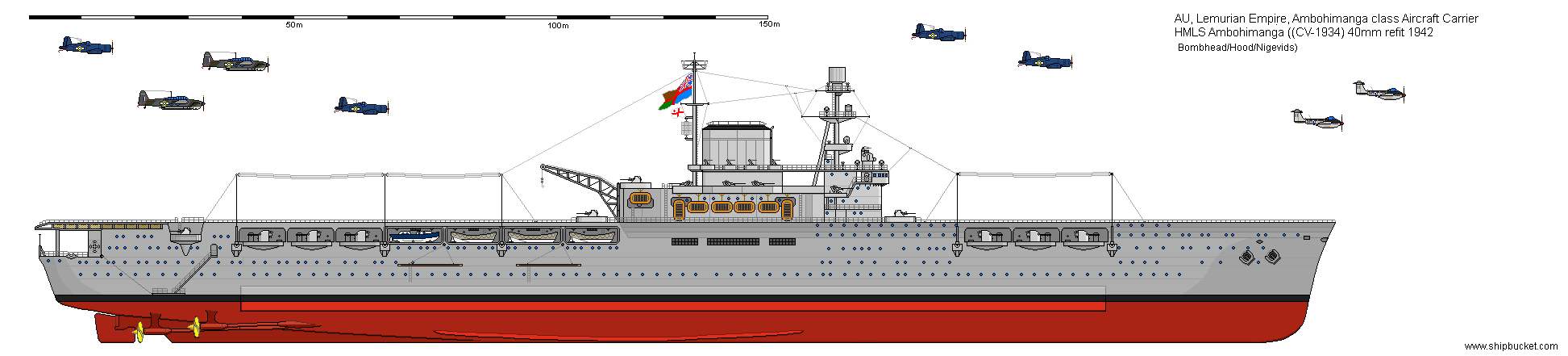
The Ambohimanga went through many refits during the late 1930's and early 1940's. Lots of new radar was fitted which created its own problems. The old WW1 model 4" were unable to be fitted for radar control and new single 4" had to be fitted. A homing beacon was fitted during this time which assisted with both dirty weather and night flying conditions. Late 1942, and the Ambohimanga is sent into dock at Atlantis for the 40mm upgrade that all Allied ships went through between 1942-1944. Once the refit was completed the Ambohimanga shuttled between Force H and the Home Fleet depending on what operation the ship would be required for. The largest of the operations was when eight CV's and 3 CVL's attacked Trondheim, home of Axis Fleet North. None of the battleships were sunk but all received major damage to keep them out of the war till Germany surrendered. One aircraft carrier, two cruisers and two destroyers were sunk with many other ships damaged to one degree or another. What the attack did was to reduce Axis Fleet North to a spent force. This would allow the Home Fleet to transfer ships to assist with the D-Day landings. Ambohimanga stayed with the Home Fleet to guard against any of the remaining German cruisers trying to interfere with either the Atlantic convoys or the D-Day landings. Most of the remaining effective German ships were withdrawn into the Baltic to act as shore support vessels against the Russians.
The Ambohimanga returned to Lemuria in 1946 full of troops coming back from their European deployment. The ship went into reserve till 1948 when it was struck from the Navy list and sold for scrap.