The two King Andriamanelo class ships nearly broke the Lemurian Bank. The two had been laid down in 1931 and 1932 and completed 1936 and 1937. The follow on Vazimba class was supposed to be laid down in 1935 but the money was just not available for what would be a 'monster' battleship for Lemuria. The best way to keep the price down was to copy as much of what they had already designed into previous battleship classes into the new ships. The Vazimba would essentially be a King Andriamanelo type with an extra turret. The rest of the world may have been going to 16" and bigger but the Lemurian Treasury could not afford it. Two ships were to be laid down in 1937 and 1938 but eventually the second ship was cancelled and only the Vazimba would be built. The funds from the second ship would go towards two new aircraft carriers.
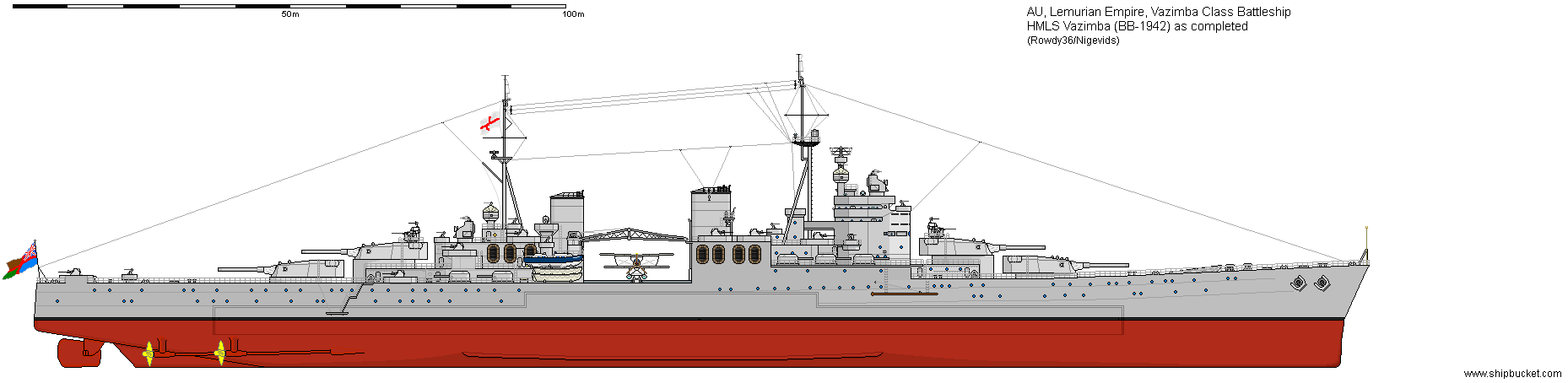
The Vazimba would copy a lot of the previous class but a lot of upgrades from around the Commonwealth countries would be made available to Lemuria to make the Vazimba as modern as possible. With just four months to go to completion, the new 40mm Oerlikon weapons came into the Lemurian Armoury, and the decision made to fit them to the Vazimba. The twin 40mm on the turret tops had onboard radar predictors but these proved to be affected by the vibration caused by the firing of the 40mm guns. The predictors would be removed and the guns operate under control of predictors mounted on the bridge.
Having cost the Lemurian Treasury an arm and a leg, the Lemurian Admiralty were loathe to put the Vazimba in harms way. The ship had been built especially as a fleet flagship and went to Alexandria in 1943 where it became fleet flagship Eastern Mediterannean. It never went within range of the German Fritz X bombers and spent a lot of time in harbour. With the return to Lemuria of a lot of the fleet elements in 1944, the Vazimba returned to Lemuria where it became Fleet Flagship of the Eastern Commonwealth Fleet. The Fleet gathered at Trincomalee ready to enter the South China Sea in support of other Commonwealth forces. When the fleet moved through to the South China Sea to strike against the Japanese the Vazimba was the Flagship sitting in the middle of six other modern battleships, but it was the eight large aircraft carriers and four light carriers that were the strike force of the fleet. The nearest to damage the Vazimba got was when a Kamikaze crashed into the sea nearby, and after exploding, sprayed a lot of splinters onto the ship. One crewman died, the only human loss to the Vazimba in WW2.
Still being almost brand new at the end of WW2 the ship stayed at Donbon as Fleet Flagship through the 1940's and 50's. Minor refits took place to keep the ship up to date with mainly the latest radar elements. The Vazimba joined other Commonwealth ships in the bombardment role off of North Korea. 1962 the ship went to Scotland for conversion to a missile ship. The Navy felt that the ship would be able to serve the Fleet for at least 35-40 years and wanted to make the most of such a large ship and its investment. It was already undertaking the training ship role due to the large crew required to man the ship. Converting the aft end to missiles would also reduce crew requirements.
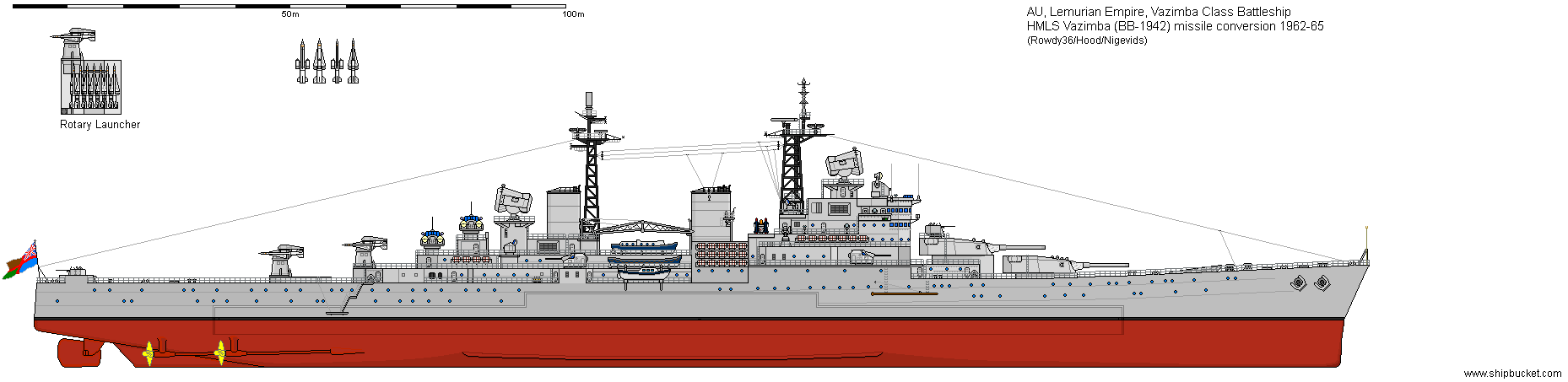
The missile conversion kept both old and new armaments to keep the ship viable as a training ship. The two forward triple 15" were kept and controlled by the MRS6 director mounted on the bridge. Four twin 3"/L70 automatic weapons were placed on either side of the fore and aft bridge superstructures and controlled by the MSR3 directors. Three twin 40mm Mk.5 mountings were the last of the gun armament with two on the stern and one on 'B' turret. The new missile armament started with the pair of twin NIGS launchers aft. The rotary launcher fitted nicely into the triple barbette area created by removing the triple 15" and all their handling equipment. They were controlled by the KT4 directors which could control two missiles per director. The other missiles fitted were the two quad mountings of the Supercat short range AA missiles controlled by the GWS24 directors. There were a lot of controller radars mounted on the masts for search and finder operations, but the ship was dominated by the two huge Type 984 3D radar mountings. Those two mountings covered the 360 degrees of the operational theater the ship was operating in. They could pick up air and sea targets and pass the data to the appropriate system for action.
The Vazimba's first operational posting after its conversion was in support of the two Lemurian carriers off the Vietnam coast. Its 3D system took tight control of the battlefield space, allowing the Lemurian jets to intercept any North Vietnamese Migs before they had barely cleared the coast. They never got near the fleet.
1982 and the Lemurian Navy answered the request for help from the Royal Navy for support in retaking the Falklands Islands from the Argentinians. (In my world that would be 'Again' - see Battle of Strait of Magellan 1939) The Vazimba and two carriers with support ships are sent in response. The Vazimba with its battlefield control systems became fleet flagship when Admiral Sandy Woodward flew his flag on the Vazimba. The Vazimba's highlight was when it moved in front of the Hermes and took two Exocet missile hits which hitting the 13" side armour did little damage. The Vazimba stayed with the fleet and saw out the rout of the Argentinian forces..
On return of the ship from the victorious Falklands campaign, the ship was stripped of useful gear, then mothballed into a museum ship.